Up To Our Knees In Lukewarm Bureaucracy

Kage Baker hated paperwork. When something came to her that required her detailed perusal – a contract, an interview, insurance or tax forms – she’d hold it up with her hands under her chin like a very sad squirrel, and make big eyes at me.

“Pleeease? Pleeease go over it for me?” she would wheedle. “Just tell me where to sign. If I look at this, my head will explode. I’ll do the same for you some day!”

Which last statement was a great and bald-faced lie, and I’d have been certifiable to let her try, too. I’d have ended up signing my internal organs away for alien research, or declaring I had 32 tax deductions, all of them adopted from Pitcairn Island. Or that my employment category was “spy” – Kage was always vastly amused by the father in Heinlein’s Have Space Suit, Will Travel, and his response to the IRS begging him not to put that on his tax returns …

So anyway, I at least vetted most of her paperwork, all the way back to mimeographed surveys in school. As we grew older and Kage’s paperwork needs grew more varied, I mostly just did whatever was required and had her sign them – I did make her listen to an explanation of each one, but I strongly suspect she was making notes on the guild structure of Flame City at the time and just nodding at me on automatic.

Sometimes, it actually took both of us to figure out what was wanted on those endless forms, anyway. Every year, for example, Kage had to get her bank to swear that she, Kage, was an American citizen and not paying taxes to any nasty foreign power. Why the bank was considered an authority on this, we never figured out. Nor why, when she’d been with the bank the last year as well, either of them had to swear to it again. The Feds changed the form every year, too – and apparently never collated them with visa records or anything of that nature, which would surely have caught Kage out at her clandestine financing of the Duchy of Lichtenstein?

Her taxes were always a lark to do, too. Being self-employed is a pain in the ass, as far as taxes are concerned; there are taxes you have to pay just for the right to receive money as a free worker. God knows why – the money doesn’t go to Social Security; apparently, the government just taxes the wild and untrammeled to keep them in line. I figure the truly wild and untrammeled are throwing those requests for money in the trash, and going on their merry way … not Kage, though. She always filed, always paid. Even the year she made a grand total of $700.00. Ah, the glorious life of a writer!

I am currently up to my ears in paperwork, as I try to claim some of the benefits from the programs I’ve paid into for the last 40 years. I have always been a very good and orderly little rat in the maze of bureaucracy – done my duty in the pink collar ghetto, typing and filing and telling polite lies on the phone and buying presents for whomsoever’s birthday the boss forgot … now it’s Payback Time, Sacramento!

But first I must jump through lots and lots of paper hoops, many of them on fire. Many more are wet and the sides of the hoops have stuck together. Yet more require that I go through backwards, standing on my head, or waving certificates of not having conditions that the State would prefer to pay for if only I had them … so eager is the government to assist with possible illegitimate offspring or STDs that I am beginning to see why virtue is its own reward: no one’s gonna help you if you’re virtuous and get sick anyway.

Luckily, although I was a good girl back when it mattered, I am not really a very nice old lady; I see no reason to be polite to the army of clerks losing my applications for things. I scream and yell and make a lot of noise, which so far has kept me moving through the glacial peristalsis of The System. And I have Kimberly – whose printing is as neat as a computer font, who actually enjoys stacking forms so they all go the same way, who never runs out of good black pens! Kimberly is my shield and buckler against the hideous troops of bureaucracy.

Kage would agree – she always said Kimberly was the most organized of us all. And if we just pass the help among ourselves like this, there will always be someone to take over for whichever of us just ran off a cliff and is paddling desperately in thin air.

It’s a good system. Someone should tell Sacramento about it.
Posted in Uncategorized | 2 Comments

Fear and Bravery

Kage Baker never thought of herself as brave. In fact, she regarded herself, in a frank self-examining sort of way, as pretty much a coward. I have no idea why, because she wasn’t – despite being afraid of a great many things, Kage always went ahead with what she saw as her duty.

But she seemed to think that being afraid in the first place lowered the value of carrying on -as if there were bonus points for blissful stupidity, that she lost out on by being more self-aware. She had a rather low opinion of heroes, per se; except the practical, common sense sort of gentleman like her own assassin, Smith.

The old truism that you can’t be brave if you’re never afraid is, in my opinion, quite accurate. Avoiding what frightens you is also sensible, and Kage did a lot of that – she had nothing to prove to anyone but herself, she said, and she didn’t care what she thought … what on earth is the point of deliberately leaning over heights, or walking through bad streets in the dark, or walking up to casual urban maniacs and lecturing them as they foam and shriek? The same rule applies to the smaller fears of life as well; there’s no point or profit in it. Does a noise on the front porch scare you? Do you get nervous when you contemplate bridges? Do guns make you break out in a cold sweat? For Gods’ sake, stay away from that shit! No one is helped by you chasing your phobias.

Better to develop, instead, the sort of personal rule Kage had. Identify what makes you unhappy. Arrange it into folders by scare factor – the annoyance of cold marketing calls ranks below the lurch of your heart when a shadow moves past the front window …  avoid the really scary stuff as often as you can ( ’cause who needs that?) and when you absolutely cannot dodge it – deal with it as quickly and quietly as possible.

That’s it. Simple, easy, convenient to remember as a plan. That business about “grace under pressure” sounds noble and all – but Kage would raise an eyebrow and observe “What a boy thing to say. No grown woman would say that. And when you’re under real pressure, who has time to worry about grace anyway?”

“But – but – Hemingway!” her interlocutor might gasp.

“Cat lover,” she’d sniff. “Mama’s boy.”

One thing she never was afraid of was other people’s opinions.

Kage always felt, as well, that she was afraid of sensible things – things that might actually happen. Big dogs, wild animals or dangerous weather. Venomous snakes, at least in areas where you might reasonably find a snake anyway; a rattlesnake curled in one of our rose pots one December mornings left her quite unfazed, since any snake out and about in that weather had to be rubber. Which it was … Kage strode unconcernedly up and grabbed it, while I gibbered from the stairs.

Bugs freak me out – not Kage. I almost crashed the car several times when giant dragonflies ran into the windshield, or a hissing beetle crawled out from under the front seat, or I found a walking stick insect perched on my collar. I screamed a lot, too. Kage would always calmly lever the offending monstrosity onto a paper napkin (They were usually somewhat damaged by the extremity of my reaction) and pitch them out the window.

On the other hand, small animals in the house were my bailiwick. Rats, mice, gophers, skunks … anything small and furry was abhorrent to Kage, to the point of standing on furniture and yelling directions at me. Though the night we got a possum stuck under the bookcase, we both retreated to the heights and called the cops. Ended up with a gorgeous motorcycle cop on the floor of Kage’s bedroom, booted legs kicking while he fished a comatose marsupial out from under her brag shelf …

Man, even meditating on fear, I wander back into the good times we had. Life was so interesting around Kage!

Kage’s bravery was intrinsic, natural, and as doomed as the Polish cavalry facing the German tanks.  She wore it like a bright scarf, or one of the big plastic 60’s rings she loved, flashing light from a glass gem on a jauntily upraised middle finger. She never once said she was frightened, during that last year of scrambling from hope to diminishing hope – she stuck it out and did what she had to. All she asked, ever, was that I not leave.

Wish I’d thought to make her promise that before it was too late. Had I done that, she might have found a way to wrestle reality into submission – she was good at that – to keep her word. I’m alone in the dark now; and I’m just not as brave as she was.

Posted in Uncategorized | 2 Comments

We Have The Edge On Change

Kage Baker disliked change. She fought it grimly in her private life, and in fact spent a good amount of time replacing things she had lost from her life at earlier dates – candies, art, outre holiday deco, defunct but useful appliances, weird toys. I must presume that EBay was founded by similar fanatics, since that’s where Kage had the best luck finding her lost treasures.

And mine; I’m not innocent in this. The electric skillet I love the best is an old refurbished GE Sunshine model – when the original from Momma wore out, Kage found me this one to replace it. Damn near my whole life long I have made pancakes, egg rolls, ham patties, corn fritters, doughnuts and Sole d’or in it, and I probably couldn’t cook without it.

The sets for our Faire work were all held in similar files in Kage’s memory. She stored them in in her head, and every year at Build, she tried to make sure they went just the way they always had. We took photos and painted lines on concrete floors for markers, buried exotically carven posts and caches of rock to mark the corners – but the final references were always the images in people’s heads: usually Kage’s.

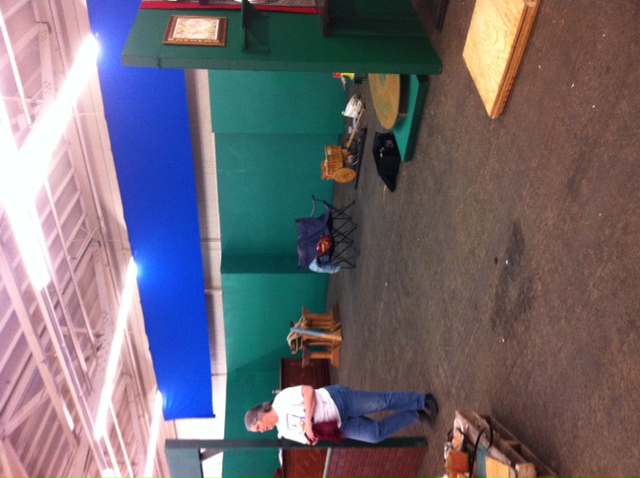
Over the years she managed to infect the Chaos Construction Corps, too; so I’ve been able to rest easy these two weekends, knowing the builders, painters and decorators at the Cow Palace are all working off cloned memories of Kage’s. And they’ve been doing a wonderful job.

However much Kage hated change, she also knew that all theatre (but especially historical or literary re-creation) is organic and alive. It mutates, it breeds with others and itself and produces hybrids that surprise everyone who sees them. As long as the heritage of the annual differences in our sets was obvious and traceable, these all qualify as “just the same as last time”.

It’s a form of logic ordinarily used by antiquities restorers and stock breeders. The handles may have been replaced on an old chest of drawers; the mirror has been re-backed, the marble cracked on the top and was mended: but we knew where it was the whole time, and it is the same piece of furniture it always was! You know the parents and grandparents, etc. for 500 years of that Long Mynd sheep – you know every cross with a Border Leicester the line ever had, you know the farm in Powys it came from; and even though it’s now technically a Clun Forest sheep, it’s the same breed!

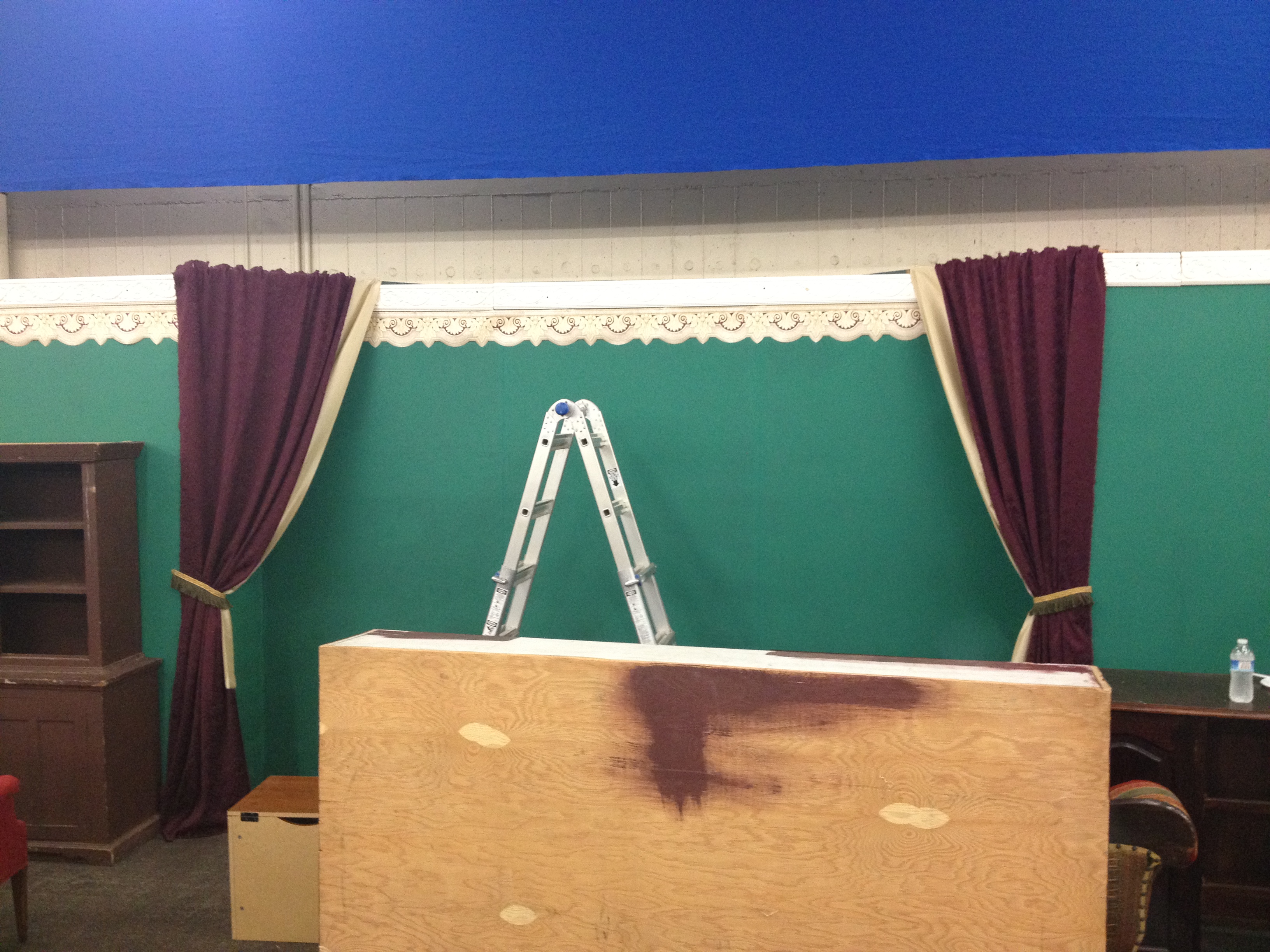
Sets are like that. So my Parlour has risen in the Cow Palace, and even though it has the odd new chair, and a restyled nook on one end, and new drapes over the Service Door by the Bar (itself only 2 years old) and the several sets of stag’s horns come and go apparently of their own free will – it’s the same Parlour. I’d know it anywhere, and so will the hundreds of nostalgic patrons who come flooding through it beginning next week.

This is how to survive change. Make sure it doesn’t happen. And if it must, make sure it’s only a slight improvement on the original design, so it actually remains just the same.

It’s the way it works on children. Children of our bodies, of our minds and hearts – they all change but stay the same. The large bearded person who just changed the ink on my possessed printer is still my little wee Mikey, who learned to walk in slippery oak leaves in the dirt Yard of the Green Man Inn. The ringleted, corseted, flashing-eyed Pocket Venus who will come skipping into my Parlour next week in a flurry of silk skirts is still baby Skye Kathleen – she drew chalked flowers all over the front table one day from the safety of my lap …

If you’re careful, nothing changes. It just grows. That’s why Kage hated change, I see now – if something changed irretrievably, it meant it had escaped and stopped. And nothing she loved was ever allowed to stop. It keeps on flourishing.

Bare nook (and Neassa)

Kitchen drapes

Posted in Uncategorized | 3 Comments

Time Like A Wheel. Or A Pretzel.

Kage Baker rather enjoyed losing track of time. She’d spent so many years of her life nailed – like most people – to the clock … she collected classic photos of clock abuse (to and by), and kept them on her hard drive as a slide show.

There’s Charlie Chaplin’s battle amid the factory clock gears in Modern Times. There’s the emo hero Freder from Metropolis – it’s not exactly a clock he fights with, but it works like one, the levers having to be laboriously hand-pointed at randomly burning lights. There’s Harold Lloyd hanging above a busy street from a clock in Safety Last. There’s the clock in the crocodile in Peter Pan, and all the deadly bomb-clocks ticking down to destruction in spy movies.

When Kage came to create the internal symbols of the worlds in her novels, the sigil for the Operatives was a sudden but obvious impulse: the clock face with no hands. Then, once the idea was in her head, Kage had to have one: and it had to be a specific size, and have gold Roman numerals on a white background … we searched hobby stores until she found what she wanted at a Micheal’s craft store, a clock face with no works behind it, intended to be appliqued onto home-made clocks in dolls’ tummies and other such whacked-out fancies.

Kage took it home, removed the hands in delicate horological surgery with her Exacto tools, and mounted it on her monitor. It was always in her sight when she wrote. I asked her it wouldn’t have been more effective to have a clock movement, that would twitch and tick as it tried to move its amputated arms around the dial? Kage said No.

“The clock with no hands has a soundless tick,” she said, grinning.

So, having disarmed Time, Kage settled into her maturity as a writer ignoring it as much as she could. She liked not being sure of what day it was. She liked marking the passage of time by whether or not we were packing for a Faire, or needed a Christmas tree, or wanted to string new lights on the porch railing. “Dinner time” was as precise as she wanted to get.

Bad enough she had to think about deadlines, which she solved by just not doing so. I got a white board and some neon-coloured felt tip pens, and wrote up a timeline of her deadlines, conventions and commitments to hang on the wall next to her barometer. She couldn’t not see that; she looked at the barometer every day and the bright colours naturally attracted her, he he he. Even when she wasn’t sure what day it was there in our apartment, the reminder that someone on the outside was going to care very, very much about the 25th of a given month was enough to make her check in temporally.

It worked. She only ever missed two dates in her career. For one, she ended up adding 2/3 again as much plot to Empress of Mars in a mere 6 weeks: she’d mistaken June for January as the due date. She did it in a sort of reverse upside down basket-weave that was amazing to see: no seams showed by the time she was done. The other one, we came home from a jolly weekend at a Renaissance Faire and found a note on our front door: Dear Ms. Baker – your publisher needs to know where you are. Regards, the Pismo Beach Police Department.

Turns out we’d been supposed to be in San Diego at Mysterious Galaxy bookstore. Kage had forgotten it, we’d blown it off, and after an afternoon of frantic calls between San Diego and New York, they all called Pismo Beach; the cops in our little town left that gently admonitory note on our door. Kage called everyone involved and explained she wasn’t dead, just senile. And we took a box of See’s Chocolates to the PBPD.

Hence the white board. And hence her enjoying floating unmoored from the relentless stream of time when she could manage it. When the police come looking for you because you missed a signing, you take schedules a little more seriously, and rejoice a little more when you don’t need them.

So, anyway, Kage liked losing track. As long as I knew where we were, or where we were supposed to be. I need someone like that now – Kimberly tries, but she’s got a husband, a son and a job to coordinate as well. Harry is no use; he likes me right where he can see me. As for the cats -!! Never make a cat your social secretary; they have no sense of time, no scruples and can’t write notes anyway.

So I plug on. The Corgi at least helps me be worried (Corgis do worried very well), which kind of reminds me I need to do something or other … today I just lost my grip, though, and that’s why I am writing this so very late in the evening.

On the other hand, remembering some of Kage’s wrestling matches with Time rather makes me smile. She won, in the end. Slipped right out of that bugger’s grasp, and strolled off the clock face entirely.

Good for her.

Posted in Uncategorized | 2 Comments

Cartoons

Kage Baker was obsessed with cartoons. That is not at all too strong a word; she considered cartooning one of the great arts, and avidly collected what she considered its gems and masterworks.

Single panel, weekly strips, animated or still – story telling with line drawings and captions was one of her favourite mediums. Maybe the house being full of old bound collections from The New Yorker and Punch may have influenced her. The comics in those, especially as painstakingly translated by a very small and only barely-literate child, were both strange and hilarious. On the other end of the spectrum, it may have had something to do with the fact that comic books were the only books guaranteed to have illustrations – a very telling point with Kage before she could read.

In fact, that was always a big selling point with Kage, for whom real books always had illustrations: it was just that as she got older, the illustrations in the books she liked to read were by Wyeth and Kaye and Parrish, legitimate artists in their own right; rather than the rotating crew, like Chesney, Webb and Brewster, who drew for Classics Illustrated Comics.

And she idolized the Nine Old Men, Disney’s core illustrators. They were responsible for most of the best Disney animation from Snow White to The Rescuers, and to Kage they were gods. She watched the decline of Disney’s animation quality and quantity with greif and fury during the 70’s and 80’s; she rejoiced when the studio rose to a glorious rebirth with The Little Mermaid and the beauties that followed. She was part of the very vocal protest against Eisner, when that short-sighted fellow declared that animation was no longer needed by the Disney empire, and she was active in the movement that ultimately drove him right out of the company.

Cartooning was serious business with Kage.

She collected the modern strips she liked best, like the collections she’d grown up reading. Her favourites were not always the most famous or popular; she couldn’t abide poor Charles Schultz, for instance, because she found his simple line not primitive but lazy.  “Writing about children doesn’t mean you can get away with bad drawing,” she would growl, and go solace herself with William Overgard’s Rudy.

And if you haven’t encountered the exquisite drawing and hysterical plot lines of that elegant Ape, Rudy, I recommend it – nay, I conjure and abjure you all, Dear Readers, to go find him. It’s obscure and little recalled, but it’s brilliant.

She liked Calvin and Hobbes, again because it was well-drawn; Bill Waterford chose a naif line for most of his panels, but the man could draw some gorgeous stuff when Calvin’s weird adventures called for it. And collections of that came out regularly, until Waterford did his Garbo and just stopped making faces. Perversely, she didn’t care for Berkely Breathed or any of the incarnations of his world; I think he was too silly for her. Kage’s silliness detector was sometimes set a little high …  she liked Prince Valiant. She liked Alley Oop. She liked Doonesbury, partly because one could watch from the very beginning as Gary Trudeau learned how to draw – the curve of increasing excellence was clear, and she admired that tremendously.

However, for Kage, the best comic of all, for ever and aye, was … Pogo. Walt Kelly had her love and worshipful admiration from her earliest days. We both used to pore over the collections of his strips around the house, amused and fascinated by whatever the swamp critters were doing (which we couldn’t read yet) and simply enchanted by the gorgeous silhouettes and backgrounds he drew.

Myself, I learned to read from the Pogo books – my spelling has never recovered. On the other hand, the beauty of an egret in flight from one cypress to another above a twilight swamp has been part of the landscape of my soul for more than 50 years. I owe Walt Kelly a lot.

A brilliant satirist, a compassionate humourist, an astute political observer and as ruthless in his satire as any Irish bard – plus, Mr. Kelly could really, really draw. And his stuff was incredibly funny. Almost every American knows at least the one line “We have met the enemy and he is us!” -but he wrote millions of words, and drew thousands of pictures; every one of them is a treasure.

There have been tons of compilations over the years – heck, they started coming out when Kage and I were infants, which is how we learned to read from them – and I have all the ones Mr. Kelly put together himself. And the ones his widow released after his death in 1973. But now, a concerted effort has been launched to get all the dailies and Sunday strips out, in good shape and in order. What a treasure trove! The first volume is entitled Pogo: Through The Wild Blue Yonder – The Complete Syndicated Comic Strips, Vol. 1 and it’s a huge, glorious, hard-cover book. And it’s mine, he he he ….

It arrived yestreday but sat unopened until this afternoon, because I mistook it for two pounds of Mullah Nasruddin’s Coffee, without which I also cannot live but wasn’t ready to open yet … then Kimberly saw the box and said, “Why would Mullah coffee come in an Amazon box?” (which I hadn’t noticed) and lo and behold! There it was!

So now I’m gonna go bury myself in it. You, Dear Readers, are warned. Go forth, ye eager multitudes, and discover what rang Kage’s chimes in cartoons.

As if you don’t already know …

Posted in Uncategorized | 12 Comments

I’m Unravelling

Kage Baker was of the opinion that anything gone wrong health-wise could be helped by sleep. She’d sleep in preference to taking pain killers; she’d sleep off a fever, or a stomach bug. And I must say, it worked – even in her final illness, sleep was the best anodyne and analgesic for her.

She always told me that a lot of my moodiness and vaguer malaises (and let’s face it, we all have them, no matter how stalwart or noble of character we are) would go away if I just freaking slept now and then. Or at least, I wouldn’t mind them as much.

I always nodded and then ignored her, convinced – like so many insomniacs – that my sleeplessness was of a higher and more cerebral state than mere insomnia. My brain was too busy to sleep, my thoughts too orderly to dissolve into the gentle nonsense of dreams.

Have you seen that contact lens commercial where some pompous idiot cries out that he can’t use mail order contact lenses because he has “special eyes”? Like that.

While Kage was in her final illness, I just grabbed sleep whenever I could – mostly when she did, which is the classic pattern for those of us caring for the terminally ill or newly born. “You’re gonna fall over in a stupor when I’m gone,” Kage warned me, amused. “You’re going to find out just how much you really need to sleep. Don’t fight it, kiddo – it’s good for you.” And then she was gone; for about a year, I slept with a depth and regularity that was astonishing to me. For the first time in my life, I was sleeping easily. And a lot!

But in the last 6 months, things have gone all wonky. (And not in the good sense, Mrs. Springhorn.) First, I stayed awake until I fell over; then I slept for 20 hours. That was okay; I could deal with that – 30 years of doing fairs all over the state had given me plenty of experience in weird sleeping patterns. But then I started to get sick … and while I know I don’t actually have narcolepsy, I nonetheless have completely lost control of my sleeping. As well as anything that bears any resemblance to a pattern.

I’ve learned, in the recent few weeks, that if I want to sleep at all, I’d better lie down at the first hint of weariness. If I do, it’s true I may sleep for 20 hours – but if I don’t, if I miss that window of opportunity, I’ll be awake for 4 days and then fall asleep somewhere inconvenient. Thus far, it hasn’t been in the moving car. I’d like to keep it that way.

My doctors say my heart is making me sleep, so as to conserve strength. Or that my body is, in general, hoarding rest against the strain of whatever is trespassing in my uterus. Or that exotic infections are exhausting me. Or maybe I’ve pissed off an evil faerie. Any and/or all of these make as much sense as the rest …

What it amounts to, though, is that the prescription of bed rest is all that helps. I sleep, all right. I sleep constantly. I wake up enough to eat, go to the bathroom, maybe run an errand and write something here – though I plain old forgot in the fugue of yestreday – and then I’m asleep again. Hopefully this can all be resolved in the near future, as various surgeries and new doctors do their things.

So this is by way of a warning, Dear Readers. I can’t guarantee I’ll write every day (though I will try). I can’t guarantee it’ll make any sense when I do – though, really, that’s been a risk since the outset … nor can I guarantee that my writing this winter will be enhanced by my presence at Dickens Fair: at this point, my attendance there is likely to sporadic.

But as long as we all realize I am on a weird schedule, things’ll be fine. Right? I’m still unravelling the sleeve of care, but now I know it – I can start knitting it up again. I admit defeat to the need for sleep, and will now try reaching a compromise.

Kage said I’d need to do that. And I didn’t pay attention, and look what’s happened now! You’d think I’d have learned to listen to her …

Posted in Uncategorized | 8 Comments

Food For Thought

Kage Baker‘s first public redoubt – where she forted up when it was necessary to seek shelter in the public eye – was in the cafeteria of Immaculate Heart High School. She had numerous such hiding places in the house and yard at home, the main one being the tiny cupola on the roof she made her room; but the caf at IHHS was where she discovered she could create one out in the open, too.

All you had to do was seize a chair and few feet of table, and either look busy as hell or glower. Or both.

This would have been harder to achieve had the cafeteria actually been a cafeteria, but it wasn’t. Not anymore. It was a big echoing chamber full of scratched tables and folding chairs, used to warehouse girls who weren’t assigned to a class or a Study Hall (we had a separate Study Hall) and didn’t want to sit outside. In Study Hall proper, silence reigned; in the cafeteria, you could talk – how much depended on whether or not a displaced class was being held at the far end, or in the assembly hall next door; but usually, it was Freedom Hall in there.

The cafeteria was where you went when you had something more important to do than study. Study Hall was not conducive to creative thought.

The room that must have once held the kitchens and some species of lunch lady was padlocked, a mystery inaccessible. But there was an entire wall of vending machines, where you could get a whole day’s worth of meals if you had enough quarters. I don’t think any of it was actually food, but you could eat it and not die. For teenaged girls, that’s enough.

Kage lived on cherry Coke and Doritos for 4 years, anyway. Me, I favoured the appalling coffee and those teeny little cans of Hormel enchiladas. I have no idea what they really were – their shape and texture suggested masa and some sort of shredded meat, but they might have been wichetty grubs in red sauce, for all I could tell. I ate ’em anyway. Kage ate her abstemious Doritos and made gagging noises at me.

The coffee was dispensed from the same machine that made tea, hot chicken broth and cocoa. Consequently, everything was slightly salty and had parsley in it. Why the chicken broth ruled supreme, we never figured out. But Kimberly said the tea was not unlike the Tibetan variety, with rancid yak butter in it; not that she’d ever tasted that, but the idea helped one choke it down.

Kage’s special place (and mine, when I turned up a year later) was the end of the table closest to the door in the northern wall. No one really wanted to sit there, because it was a high traffic area and the doors were far from weather-tight. A frigid draft blew through them at all times, and in strong storms they had to be braced shut with garbage cans. But it meant the end of that table was always free for us to hunker down at. Also, the bit of wall beside the doors, where Kage ran a penny pitching games for most of her high school years.

At that end of the table, she drew vast panoramas and intimate profiles of what would turn out to be the various worlds of her novels. She wrote reams and reams of first versions, too; in the neat metallic-cover legal pads our bookstore carried, with a Rapidograph also purchased from there. When asked, she would also tell fortunes with her Tarot deck, at a quarter a pop. “You have to pay the Fates or it’s just nonsense,” she would explain to the anxious maidens who sought her counsel. That’s also the first place I heard her intone, “The cards never lie. The old gypsy woman, she full of shit; but the cards never lie.”

I was especially useful as a place holder at that table, because I spent every spare moment of high school lying flat on my back on hard surfaces. I was ultimately found to have a kink in my right ureter; at intervals, it would shut down the highway between my kidney and my bladder. Mind you, the kidney worked – but there was no where for the fluids so produced to go. The pain was extraordinary. And until an attack relented, my only recourse was insane amounts of pain killers, and lying flat. Hence my part-time career as a book holder; three girls a side could use me as a prop for textbooks, and still have room to turn pages. I would lay there, ears gently ringing, and discuss the probably physiology of the Children of the Sun with Kage.

I wish I was there now. With Kage, on that horrid table, with the icy wind blowing up our skirts from the door; discussing how the lungs might work on a being that could breathe fire … listening to Kage tell some fretful 15-year old that you had to pick a significator from the Tarot deck based on what your real hair colour was … munching the occasional parsley sprig in my coffee.

I feel just as much like crap as I ever did in those days – all the sturm und drang in my pelvis has woken up my damned kidney, which is taking a little romp like Memory Lane today. Makes me recall how I longed to have it taken out and fed to Kimberly’s cats.

But, you know? All this reminiscing has a good point. It conjures Kage’s young face for me – glittering black eyes, the freckles on her cheekbones standing out like cinnamon dusted over the pale skin. Telling me about the indigenous wildlife of the Western Isles where the Children of the Sun went sailing, looking for wine grapes and treasure and nymphs …

I think I’ll go lie down and dream a little.

Posted in Uncategorized | 7 Comments

A Legacy Paid In Cats

Kage Baker did not like cats. She said so at frequent intervals, avowing a deadly dislike of feline kind and maintaining a loud enthusiasm for their extinction.

This was a pose.

The fact of the matter was that Kage was mildly allergic to cats; she preferred not to have them sit on her or rub their velvety little histamine-loaded faces all over her. Naturally, this meant that every cat she met wanted nothing more in its entire life than to live in her lap. This did not endear them to her, as Kage took animals as she did people – on their own terms – and thus saw all this wet-nosed, cat-dander affection as a deliberate political affront.

“They do it because they know I don’t like them,” she would say darkly, glaring at some adoring pair of slit-pupilled eyes.

“Naw. They just like you and don’t care that you don’t like them,” I would assure her. But it didn’t comfort Kage much to realize that the basic nature of cats is that of Nature’s stalkers …

Actually, Kage had been very fond of a 3-legged cat in her childhood. Mitz was rejected by his mother, rescued by ours, and nursed to a healthy adulthood. He was a gorgeous black cat with a fine Egyptian profile; he was diffident, calm, and very much a gentleman. Kage always regretted she hadn’t been older when she named him – she’d have named him Richard, for his hunched left shoulder and limping gait. Mitz had a sort of melancholy Olivier dignity to him, even when stuffed into a fruit cake tin and being borne about the yard by an adoring toddler.

She was also fond of a couple of my cats. T’Pring was an enormous hybrid, a cross between a Persian and a bobcat: tufted ears, enormous snowshoe paws, and a personality that just barely accommodated domestication. She was spayed during her first heat, and it evidently stuck her there: she was eternally amourous, chasing (and catching) tom cats. Her tail curled forwards over her shoulder like a sable feather boa. She reminded Kage of Don Marquis’ Mehitabel, and amused her no end. Besides, she was a very competent ratter, and Kage would always cut someone slack for being good at their job – even if they were a huge nymphomaniac cat.

She tolerated my little Thesta, too (named after a character in one of Kage’s own stories); mostly because she was small and tidy and celibate and quiet. Not the fabulous T’Pring, in other words. And Thesta was an even better hunter, habitually bringing home rats half her own size, that she had chased and killed on the wild Hollywood Hills. Kage did hate the rats,though: after a while, she wouldn’t open the door when Thesta could be heard knocking hollowly on it, because it meant she was slinging a dead rat at the door panels over and over …

Eventually, though, we ran out of cats and changed up to parrots. Then, for decades, Kage ionly had to worry when we visited people who kept cats; because they loved her and would come slinking around in ardent admiration to make her sneeze and glare. Did they come to me, who actually liked ’em? No. It’s a cat thing.

So why am I going on and on about cats tonight? Kage didn’t even like them much, and recounting their hopeless adoration of her only amuses cat people.  Well, the reason is thus: I seem to have somehow inherited Kage’s cat magnetism. I like cats quite a lot, but most of them over the years have been merely polite to me – as cats tend to be, once they establish that you are harmless and maybe useful.

Also, I am very tired and sore tonight, and I can’t find a place to sit without some velvet-pawed little person coming up to adore me. So they’re on my mind. And my lap. And my desk. And, all too frequently as I try to write, my keyboard.

You see, my sister Kimberly’s cats have developed an insane affection for me over the last year and half. They cling to me; they steal my shoes, and hide in my knitting. The little black cat is, even as I write this, laying on her back between  my keyboard and my computer monitor – all four paws in the air, her tail waving gently in front of the screen. She’s butt-dialed my phone twice. She regards my desk and all the machines on it as 6 Flags For Cats. Especially the bits that once belonged to Kage.

The older cat, who usually behaves like Miss Haversham, has decided I am Estella. I am now the recipient of her chilly, ice-matron affection, which she has never bestowed on anyone before. Except, futilely, Kage.

So here I am, pretty much covered in cats. It’s only happened since I moved back down here, and it gets more covetous all the time … good thing I do like them. Even if I suspect that their affections is at least half an “At Last!” sort of thing, as they cling to me in lieu of Kage who would never pet them.

One of Kage’s weirder legacies, if so. Though I can’t deny it’s soft and purrs most sweetly. If only it didn’t sit on the ENTER key …

Posted in Uncategorized | 3 Comments

Building Weekend

Kage Baker loved building for Dickens. This, the second weekend of rehearsals, is when we usually get the walls of our Parlour up – and she loved that task. The bustle and energy, the giant-jigsaw puzzle of the set, the innovations and repairs and desperate improvisations necessary to get the wall up and standing: it was all the most intense delight for her, an engrossing fever of making.

Not that we let her up on ladders if we could help it, or allowed her to run loose with power tools: that tended to be dangerous. But she was a true maker, and the completed form of the Green Man Inn dwelt perfect and glowing in her head. She was also inspired with small details and tricksy hand-eye deco – the little, glittery, cunning stuff, the improbable details that made the place. The palm trees in brass planters; the deliciously fussy layers of moulding, wallpaper and painted walls; the antimacassers and fruit bowls and china shepherdesses and hand-tinted prints on the walls … everyone has contributed to our incredibly crowded Victorian deco, but it was Kage’s demand for “More stuff!” that started it.

She knew how it should look. It pleased her beyond words to see it go up, the image in her mind taking over-decorated flesh there between the cold concrete walls of the Cow Palace. And that image in her mind leapt like a contagion, like a forest fire, from mind to mind until all of us were infected with it. She’s two years gone, and the Parlour is still going up just the way she wanted it.

Heck, I wasn’t even there this weekend, but I know precisely how it must look: because I know my stalwarts have built it just the way Kage designed it.

I wish desperately I was there. I miss the long, eldritch drive up I-5, I miss the light on San Francisco Bay, the way the lights of downtown make the buildings there look transparent in the winter twilights. I miss the relief of a clean bathroom and a decent latte at Starbuck’s in Buttonwillow. I miss the sundogs by day and the streetlights of Elfland by night. There is no side of the road like the side of I-5, and I miss the traverse of the weird it always grants me.

And I miss my folks. Neassa, Mongo, Mike, little Mat; Adam, Jenn, Toby, Tom. And Tom. And wee Tom, with his daddy David and brother Jesse. All my swan-like ladies – Shannon, Liz, Jenn, Sally, Denise, Michelle, Kelly. The kids, growing taller and more numerous every year. Our mated dulcimer players, DJ and Buffalo. All the some-timers and part-timers and when-they-can-timers, who come to us for shelter and provender and drinks, and to help move the tables and do the dishes when we need them.

Most of my family lives up there, all together for a few weeks every winter. In the Cow Palace. In Dickens’ London. In one huge faceted gem from Kage’s mind (itself  like a box of Oriental jewels) brought out and set up for each Christmas.

Oh, I miss them all. Kimberly and Neassa are both telling me that Kage wouldn’t want me to drive up in poor condition, and so I’ve been reasonable for two weeks now. But reason has an end! Art calls!

Next week, I’m headed up no matter what!

Posted in Uncategorized | 4 Comments

11/11/11

Kage Baker was the proud daughter of a veteran. She was the cousin, niece and aunt of several, too; the sort of American family where military service is a part of the normal part of life, and not a subject of unusual scrutiny.

There are myriads of families like that – lots of their sons ( and now daughters, too) go into military service because … well, that’s one of the things real people do. You pay your taxes, you go in for jury duty, you suit up and spend your time in the service of your country when you can and must. It’s not an attitude that calls for posturing or news conferences; it’s the bred-in-the-bone patriotism that makes every adult citizen as responsible for our country’s safety as they can manage to be.

Girls were not yet especially welcome in the Armed Forces when we were young, and no one would have taken Kage anyway: her eyes, her nerves, her dreamy unawareness of authority …  Me, I applied to the Air Force (I wanted to go to space, ha ha) but one look at my eyesight and they stifled a laugh and said No. Besides, it was just before girls got to fly (I’m older than you are, Becky!), and they had no use for me other than for the receptionist work I ended up in on Civilian Street. But I tried.

The men who go to war from these families don’t talk much about it afterwards. One of the things I have noticed, from my relatives and playmates and lovers, is that men who saw real action are often quiet about it. And now that women are doing it, too, much the same attitude prevails. Those who dream  hungrily of battle are seldom those who ever had to face it; the war stories I have heard from the veterans in my life have mostly been brief, thoughtful, in the middle of the night conversations. Often, they’ve been nightmare soliloquies from the sleeping.

There’s a hill somewhere on the border of China I have heard taken a thousand times; a thousand times, too, the sergeant and medic both buy it before anyone makes it to safety. There are mortar barrages against hot cloudy night skies in Vietnam I’ve heard narrated in three languages. Neither of those story-tellers talked about them, though, when they were awake.

The agonized poetry that does come out of those times is memorized by school children, who don’t get the goosebumps from them until years later – but the point is made, the blood remembers, and for the rest of your life you weep at the poppies of Flanders Field. And it’s the silence of the actual participants that demand we remember this, that requires us to recall and mourn and honour all those men who have been silent since their own times under fire and hell ended.

That’s pretty much what today is for, I think. Kage thought so, too. She wore a poppy, always. It used to be easy to find them; lean old men in dress blue and white handed them out at bus stops, or on the porch of the church after Mass. It’s gotten harder to find them these days – the one on my desk is a decade old – but they’re there if you look. Go to an American Legion Hall, track down the Veterans of Foreign Wars, or go walk among the snow-drop lines of headstones in the Veterans’ Cemetery out on Sepulveda: someone will hand you one.

If you can’t find one, make one. Kage and I did, more than once. Some crepe paper, some florists’ wire, some red, white and blue tape – if you ever made crafts flowers in school, you can make a veteran’s poppy.

War is not good, soldiers don’t want to die, and most hope that we if we take up their quarrel with the foe, we’ll have the sense to end it. But in the meantime, it behooves us to remember those who suffered and died for us, the living.

Thank you, ladies and gentlemen. Thank you.

Posted in Uncategorized | 4 Comments