Back At The Pop Stand

Kage Baker was fascinated by extinction. And cryptids. They sort of go hand in hand.

She was well aware that all species go extinct eventually (so far anyway) and that most manage it without human intervention; but she was also concerned that so many are helped over the edge into the abyss by humans’  cleverly-evolved hands. The survival of the supposedly extinct was, of course, part of the foundation of her Company series. It was part of her personal desire to find a pattern and a point in all the “now you see ’em, now you don’t” carryings-on. And then, she also cheered happily when some determined species was discovered not to have died out after all.

She was also intrigued by cryptids – organisms assumed to be mythical, that then turn out to be real. The big flashy ones get the most publicity, of course – not only because they are just plain easier to see, but because people place more emotional value on animals that are large, or furry, or romantic. Cryptid plants turn up from time to time – but what gets the  big spreads are cuties like the Columbia crested rat (which resembles a ginger tribble) or the giant rat found a couple of year ago happily still extant in a dormant Papuan volcano crater … I mean, how can you beat a giant rat in a volcano? Even multi-coloured extremophile Archea in hot springs can’t compete with that.

A butterfly found to still exist in one meadow next to an oil refinery. The horses painted in the caves of Lascaux – heavy-headed, potbellied, striped – found still being bred in Basque mountain villages. Twenty-five thousand lowland gorillas living unharmed in a jungle separated from everywhere else by insanely martial humans. The eastern Atlantic right whale, occasionally surfacing among its western brethren, persists in being not quite gone.

There are tons of other examples – the bongo, the giraffe, the okapi, the giant squid. All of those were considered mythical at one point, and then found to be ever so real. And of course, the totem animal of extinct/cryptid/unexpected beasties: the coelocanth.

All this started for Kage because Momma mistakenly told her that puffins were extinct. They weren’t – and Kage was delighted find this out – but her first personal experience of extinction was thereby the “returned from the dead” model. First impressions were very, very important to Kage. They affected her strongly. The story of the puffins just convinced her that nothing ought to be gone forever; and with a little care and luck. nothing needs to be.

And from there, it was just a matter of working out a method to save things. In her own mind, anyway; in an alternate world, in another dimension. In a story, where she could tell the careless world: “Look, you morons – you don’t have to kill everything! If you just hold back your hand a little bit, all these things want to live!”

She really, really hoped for proof of Bigfoot. Partly it was the monster-story giggle of it; the tales of Sasquatch encounters range from ludicrous to blood-curdling, which appealed to the story-teller in Kage. The physical evidence is so peculiar as to be fasinating; indeed, the fact that there is any physical evidence (and there is, Dear Readers, damned weird stuff, too) intrigued her all on its own.

Kage always wanted to see a Bigfoot … I, on the other hand, was pretty sure I would first wet myself and then die of terror. So it’s a good thing we never encountered one.

Anyway! During my brief waking moments the last couple of days, I found some interesting comments of the resurrection of lost species: very heartening, really. I am coming back to normal broadcasting here, I promise.

Things like a little article on io9 (http://io9.com/5822783/10-extinct-animals-that-have-been-rediscovered) which is not only heartening and fascinating, but a good springboard to further research. This is just the sort of thing that stirred stories in Kage, when she could find some such creatures strange enough to provoke a plot device.

I mean, who knows what could be made of the Cuban Solenodon’s survival? There are very, very few venomous mammals in the world, and the solenodon is one of them … on that island of mystery, ideology and frantic spies, who knows what a tube-nosed ferret with poisoned fangs might get up to?

Well – Kage, obviously.
Posted in Uncategorized | 2 Comments

July 21st

Kage Baker will forgive me the occasional placemarker. The other side of her inhuman determination was an occasional fit of whimsical self-justification for doing nothing.

I’ve been asleep for something like 18 of the last 24 hours, and am only now approaching actual wakefulness. I’ll probably be awake for three days, next. My already eccentric sleeping patterns have gone completely bat-shit crazy. Actually, a bat’s sleep patterns would be more convenient than mine right now.

I am toying with the idea that I originated on some planet with a longer day than here, and am now reverting to type. Or pupating into some incomprehensible adult form. One with really annoying sleep cycles, though I am also hoping for wings or a tail …

If I cannot sleep tonight, I’ll get up and write, Dear Readers. If I can sleep (or, more likely, cannot prevent myself from sleeping) I will hope the narcolepsy restores me to something like a normal circadian rhythm. It doesn’t have to be an specific amount of time – just one sleep period and one wake period happening in the same 24-hour cycle. Something old-fashioned, vaguely classical, you know?

In the meantime, I haven’t officially missed an entry today, so I get minimal brownie points, at least.

Back tomorrow.

Posted in Uncategorized | 1 Comment

It Ends. Everything Does.

Kage Baker, like so many millions of others, loved the Harry Potter stories. She was grateful the last one came out when it did; much as she had enjoyed the movies, she would have been sad to die without knowing how it all ended.

We came rather late to the phenomenon, at the third book. By that time, all the nephews and nieces were glassy-eyed devotees, the younger ones improving their reading so fast it was frightening. Then, one day while buying supplies for a weekend at Faire, we found all three volumes on sale at Costco: enormous books in bulk for cheap! We bought them, along with the usual gallon of mustard, bale of toilet tissue, and half a cow ready for the spit. And then we were hooked.

When one of the books came out during a huge family weekend in our Pismo backyard, every single copy in the local indie bookstore was purchased by the children in our household; I had to drive into San Luis Obispo to get one of my own. By the time the last one came out, we matter-of-factly ordered two copies – so neither Kage nor I would have to lie about in anguish while the other one read the prize. The books arrived on a Friday – there was no conversation in our house for three days.

Today is my sister Kimberly’s birthday, and we went to see Deathly Hallows Part II. Don’t fret; I am not going to talk about it or dispense spoilers – is there anyone who cares who doesn’t know what happens anyway? They did a good job. I was pleased with it. And I cried, though not because it was the last movie: the books will live on.

No, I cried for the utterly selfish reason that the movie set me up for another ambush. It’s happening less often nowadays, but I am by no means cured – from time to time, something reminds me of the loss of Kage, and I fall apart all over again. I’m really, really tired of it; I wish I didn’t do it; it happens anyway. I think the only defense might be to avoid any reminders of being alive, but that’s not something I could do even if I wanted it. Something would come find me in the middle of the night, and I’d dissolve again anyway.

But it’s hard. It’s so hard. Scar tissue hurts, too, but at least it stops bleeding. I haven’t managed that yet (though I keep thinking I have); the black tide of grief still rolls right over me and drowns me when I don’t expect it. Harry Potter is, on the face of it, a damned silly thing to remind me – but when you get down to basics, it’s a story about courage and love, and magic and the power of trust and dedication and … I lost a big old chunk of all that.

Grief and pain and loss don’t end. Whoever claims they do is ignorant or a liar. They get better, easier to bear; they never go away. Not unless what you loved and lost dies inside you, as well, and who the hell wants that? But sometimes it hurts so badly that I stomp around and swear and bitch and howl at the moon. Just ignore me; it’ll go away. This is all just static on the radio of metaphysics. It’ll fade again, and our usual program of pedantry and bad jokes will resume.

Life really is magical, thrilling and beautiful. Life with Kage was something like doubly so. I’m just missing my fix, the days of riding with the Wild Hunt with an ice cream cone in one hand and Dance Hits of 1565 on the radio. But just because I no longer live in one of myriad alternate worlds inside Kage’s head doesn’t mean I no longer want to live.

And so now: I am off to get an ice cream cake for Kimberly. It’s a lovely summer afternoon, and there is Chinese food in the offing, and it’s a birthday! There is still so much to live and do and see and feel!

Just … sometimes you have to stick a fork in your leg to make sure it’s still got feeling. That’s all.

Posted in Uncategorized | 5 Comments

Summer Lightning

Kage Baker was often struck down by migraines in hot weather. Especially during Northern Faire, in Marin – when we ran into late August and September, the heat would often reach triple digits in the late afternoon. A demon wind would begin to blow in the from cow-pasture parking lots, laden with dessicated wild oats and peat dust, and Kage’s brain would red-line and short circuit.

They always struck her speech first, and her eyes. Either she would go helplessly mute or begin to speak in total nonsense: then go mute. No glossolalia, per se – she spoke English words– but they were disconnected and unattached to the present situation. When she suddenly commented that the clouds were too sharp or my voice blue; if I looked up to see both her frightened eyes looking straight at me – I knew she was having a migraine. The strabismus vanished when Kage had a migraine. I have no idea why; nothing she saw then made sense to her, which drove her mad with frustration.

However, pain and nausea would also attend these brain storms, and the only real treatment was as much caffeine and painkillers as she could keep down. And then putting her to bed. She’d sleep for hours and ultimately wake up feeling clear and hollow as a bone flute (she said) and furious at being once more struck by lightning.

She was convinced that wearing crystalline stones made it worse. I don’t know – many crystals have strange EM effects, especially quartz: of which Kage was, perversely, very fond. After a month wearing a necklace of amethyst, rose and smoky quartz – and being crippled with migraines over and over – she eschewed wearing them ever again. The migraines diminished. Real EM interference? Psychosomatic TIAs? Maybe Kage was simply unable to tune her brain waves in properly with all that rock crystal around her spinal cord. It hardly matters – she put the stones away and got better.

I don’t have the interesting disorders of the speech centers poor Kage did. I don’t even always have a lot of pain with a migraine. What I have is that total visual distortion effect, the masking of the world by a scrim of metal lace. Steel and chrome patterns drift over everything I see, shining thorns twining and expanding. Like Kage, though, the heat makes it worse.

Today it’s in the 90’s here in Los Angeles. It’s also astoundingly clear, a hot wind blowing and everything limned and lined with searing white light. I can feel lightning bouncing off my skull, and the black thorns are rising in front of my eyes like a fast forward from Sleeping Beauty.

Time to have a big cup of Mullah Nasrudin’s coffee (got fresh beans just yestreday!) and go lie down. I’ll get up when the moon does, and go bathe my eyes in her light. Kage always swore that helped.

Tomorrow: some more of The Fog King, if anyone wants some.

Posted in Uncategorized | 7 Comments

Lights In The Dark

Kage Baker slept. At least as an adult – when she was a kid, she had insomnia and was frequently up until well past the television sign off. Back when television stations did sign off. And they did once, Dear Readers. As some of you know.

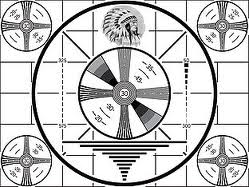
I have never slept reliably at night. Consequently, we both saw a lot of  test patterns and heard the National Anthem frequently, as even the local monster movie channels went dark by about 2 AM. Discussing it many years later, we both decided we rather missed that quaint ritual, especially the old Indian Head Test Pattern.

The light from the black and white telly was a lot like moonlight, blue and cold, and years of our childhood were lit by that. While it could be depressing if you were the only person still awake – the rest of the household lying pale and faintly glowing in its light, like vampires – it was also a sort of constancy. Someone was out there, keeping the carrier wave going. One was not quite alone.

When we went to Pismo for vacations, the after hours display got even weirder. Well into our 20’s, there was only one station you could pull in at the local motels. It signed off at midnight – from 12 to 6 AM, all you got on the Gold Coast Network (ha!) was a slow camera pan back and forth across a wall. It swung between a temperature gauge and a barometer: silent, inexorable, displaying infinite gradations of information on two measures that changed maybe twice an hour … but I remember sitting awake with Kage and Anne, all of us solemnly tipsy on some hideous concoction of Kage’s, earnestly discussing literature and history and staring transfixed at those two damned gauges, wondering what would herald the dawn.

“What’s on at 6 AM?” Kage would inquire.

Anne (consulting the combination tide schedule and TV Guide): “Scooby Doo.”

“Ooooh, shit …”

Nowadays, of course, there are hundreds of television stations available, and none of them ever goes off the air. The daily ration of weirdness has to be garnered from infomercials (What planet was Tony Robbins from, anyway? That man’s skull was square.) and TV Land broadcasts of the unbelievably bad shows we watched in the 1970’s. Test patterns are gone; and frankly, no one’s channel ID icon is anywhere near as cool. CNN with a Darth Vader voice-over came close, but – no.

All televisions are colour now. Half of them aren’t even televisions, they’re computer, phone and tablet screens, and none of them are cathode ray tubes anyway. That doppelganger moonlight has all but vanished from darkened midnight living rooms, where sleepless little girls once tried to figure out what the hell was actually going on in  chopped-up showings of The Maltese Falcon and White Zombies

Enter my new Kindle. Yes, I am still in the throes of infatuation with my newest techno-toy, because it works just like it said it would! It’s light and easy to hold, it reads like a book, I can buy something new to read from my desk in the middle of the night. I tell you, aside from the still-missing flying cars, this is one of keenest fruits of the future yet. Instant books!

When we moved permanently to Pismo Beach, we discovered that the library system was small and bookstores were few. Luckily, we got on the Internet within a year and discovered shopping for books by computer. As Kage said, that was all we needed to make our exile in the boonies liveable. The Kindle is even better.

And now that I have added a cover and a light, two new joys have been added. I can read much more comfortable in bed, and that magical blue-white electronic moonlight has returned to share my sleeplessness. It shines on my Kindle, coolly comforting – and since it rises up on a neat little War of the Worlds laser-gun neck – I can aim it around the room at need. This is handy when the corgi is talking in his sleep and making goblin noises. Also, I can light my way to the bathroom with a book.

Now that, Dear Readers, is a modern miracle.

Test Pattern

Posted in Uncategorized | 5 Comments

Sunday Goodies

Kage Baker liked Sunday breakfasts out. She had favourite restaurants, as opposed to favourite dishes – it was the ambiance of specific places she craved; once there in the place she wanted, she’d usually order the exact same thing every time. What she ordered depended on what the kitchen did especially well, but her default choice was always scrambled eggs with tomato and an English muffin. With a view of the gardens, if they had any.

Some places did French toast especially well, or some unusual omelette – at The Gozabo in Avalon, she always ordered a sausage and green onion one, something she ate nowhere else: because no one else made the sausage from local wild pigs. At Cliff House in San Francisco, she always ordered a hangtown scramble – eggs and oysters, and popovers – because it sounded (she said) like something Edward Alton Bell-Fairfax would eat. I’d have eaten damn near anything, myself, for those popovers. They are the plus non ultra of popovers, at Cliff House.

One restaurant in Novato had the best hot chocolate in the world. For years we ended every Northern Faire there, breakfasting in luxury before we went back to strike our set.The Cowgirl Cafe in Pismo served ONE sausage patty as a side dish: it was almost a foot across, a veritable manhole cover of sausage, and Kage ordered it when she was feeling carnivorous. The Latitude Bar and Grill in Pacific Grove has the best bacon in the Universe, worthy of the Welsh princes who stole pigs from the fey.

Kage kept them all in her book of memory, and composed Sunday breakfasts out of them wherever we were. She had only one caveat – under NO circumstances would she travel after a breakfast of pancakes. It was bad luck. Eat pancakes, stay out of cars – the only time she ate pancakes, therefore, was at home when she was resolved not to go out. Or when we were at a hotel restaurant, and she knew she wouldn’t need a car at all. Science fiction conventions were pancake territory.

We went and got a nice bespoke breakfast this morning, Kimberly and I, fetching it home for the gentlemen. For a variety of reasons, including two of them not being human, the 4 gentlemen in our household do not drive … a lovely time was had by all. As I hope your Sunday breakfasts too, Dear Readers, were worthy of this bright warm day and left you all happy and satisfied.

But now, for dessert – a little more of The Fog King, eh?

The Fog King, continued

You learned letters and numbers and colours at home. Your Momma and the Many Aunts gave you baby slates and blocks and wonderful chalks and crayons and paints; but you had to memorize their names and combinations to get the toys, so you learned because you wanted them.

And while you weren’t allowed to run in some halls (though the big girls often did, but big girls got away with a lot), in others you could. And in some, you had to run; corridors and rooms with trumpet signs were running spaces, and they moved around for fun. The Many Aunts noted who took paths through the house that let them run more than walk, or vice versa, and if you liked to run, you got to learn baby tumbling. And they took you out to the parks and the shops by the seafront.

Axe Bay was a wide irregular crescent of a city along the two-winged bay. The South Blade was mostly mercantile; the North Blade was mostly residential. The Haft was a straight avenue through the center of the city, with the Ducal Palace at one end and the harbor lighthouse, the Spike, on the other. The Spike rose up on the very tip of the promontory that separated Left Blade from Right, surrounded by the long wharves.

The long curve of Guard Street fronted the Bay, with warehouses and chandleries and rope walks and shipyards and sailors’ pleasures lining the Left Blade side. Along Right Blade there were parks and beaches, more and more expensive shops, fancy hotels and baths; rich houses rose in the streets further inland. The Lacquers lived on the Right Blade, of course, but when you went down to Guard Street you might end up anywhere. It depended on whether an Aunt or Momma or the big girls took you.

It was nice with Momma, but the best times were with the big girls: because Momma wanted you to learn things, while the big girls just wanted you not to interfere while they had fun. So you got to visit everything, and as long as you saved your questions for afterwards, even the big girls might explain what you had just seen. If you told on the big girls, you probably never got to see the inside of a sailors’ bar again – but if the beards and tattoos and noise scared you, Wenekla thought, you didn’t want to see them again anyway. She liked them.

What she loved best, though, were the carts, the vendors’ carts. She loved them better than the shops, where you couldn’t touch things. They ran the whole length of Guard Street, parked all over, manned by their shouting owners. The only real difference was that the carts on the Left Blade shouted more and had brighter colours. And they sold cheaper noodles, dumplings, sandals, scarves, maps, charms, sausages and dolls on sticks, wine and lemonade in funny cups chained to the carts, jewelry … you could find anything in the wide world along Guard Street, and between the two Blades you could probably find it twice over. But you’d spend copper on the Left and gold on the Right.

Wenekla preferred the Left Blade to the Right. You could get more for a penny, which was all she usually had. There were more interesting people walking around. Better still, more of the people were children; best of all, some of them were boys.

Pelk’s father ran a fried seafood cart. Balish’s mother sold ribbons and laces. Red Davo and Black Davo denied any parentage; neither were they brothers, but were called after the colours of their hair and wandered the wharves like a pair of mismatched kittens from the same litter.

They were Wenekla’s only friends until she went to the Sisters when she was six.

Posted in Uncategorized | 3 Comments

Another End-of-the-World Weekend

Kage Baker commented once,  “The world ends for someone every day.” A lot of her Company series was based on that observation, and all the sorrow that arises from it. Also, its corollary – that worlds are saved every day, too. We are all unlikely survivors of a thousand Armegeddons; we just don’t know it, most of the time.

By her calculations, she and I had both been living on borrowed time since our second years. That was the first medical emergency for both of us – Kage’s was a bad infection, mine was a tumor. Medical science saved us. It continued to save us over and over, through really quite decent lifetimes; it was only the very last challenge to which it proved inadequate for Kage.

She actually thought that was not too bad. She said, “Hey, I lived past breeding age! That’s success. And I had the offspring I wanted – every book I finished is my child. I get to leave a legacy, and that’s what evolution is about, right?”

Me, I think  evolution might be about slightly more than that, but I see her point. And there is the Auntie thing, too; many intelligent species (elephants, dolphins, some primates) spread out maternal care through the mother’s female kin – you get more, healthier, better-educated babies that way. And your own genes are carried on as well, if you help your sibling’s progeny learn to swim in the local gene pool.

Kage was a very successful Auntie.

This weekend, here in lovely Los Angeles, the media is eagerly prophesying yet another Armegeddon. The 405 freeway through the Sepulveda Pass closed at midnight, and will stay closed until dawn on Monday. Ten miles of the busiest freeway in the world is out of commission – how, oh how, will we ever survive? The media dubbed it Carmageddon (I hate puns) and has been slavering over the anticipated chaos for a month. There are journalists from all over the world out there in the Pass, watching the earth-movers and waiting eagerly for the city to grind to a halt.

And nothing bad is happening. The freeways are clear (the only Sigalert in the entire Basin is the Sepulveda Pass itself), the construction project is proceeding apace, and everything seems to be working. Just another End of the World in Los Angeles – apparently, even with advance PR, Los Angeles doesn’t end until it decides to.

My palantiri show me that the scene is orderly and efficient:

http://abclocal.go.com/kabc/feature?section=resources/traffic&id=8251473

The only thing that looks incautious to me is the placement of the chemical toilets. I can find only one, which seems inadequate. Also, it’s placed in the sun with no shade at all – and if there one thing 30 years of historical recreation has taught me, it’s the horrors of unshaded chemical toilets. So there may yet be a splashy disaster for the media to report … but I doubt it.

Maybe a journalist or two will drop from heat exhaustion or OD on bottled water – which will be as sad as losing a rare leech species. The rest of us, though, will just keep on keepin’ on. That’s what life does.

Tomorrow: another bit of The Fog King

Posted in Uncategorized | 2 Comments

Notes

Kage Baker, as I have often said, left me notes.

Some of them are little snapshots of shopping trips 20 years old, her neat calligraphied script detailing old menus and sudden cravings – oh, God, that summer where we compulsively poured George Washington Brand Bechamel Sauce over everything! Some are packing lists for Faire weekends (4 pairs of socks, my bollocks knife, ink bottle, rum). But some are notes on stories. And some are rather more than just notes.

I keep finding pages of stories. None of them are complete, and most are very old; ideas that ran through Kage’s mind one day and were recorded for as long as she had time to spare. Others are just cryptic outlines – quartz focuses mental energy. Migraines, weak mind, bad control? Find out about Salvia Divinorum. Throw this note away! But she never did, because she couldn’t throw things away, and it has risen to my hand over the last year like a tickled trout in a quiet stream.

Some of the notes are fortified by years – decades – of conversation in my memory. Some are on topics I barely remember. Some are flat-out surprises, or something Kage used for something utterly else over the years. I’ve begun piecing some of them togethera Mars story, the Sad Tale of the Stupid Little Nuns (that’s what Kage actually called it), recollected scraps of the legends on which she built her own worlds.

Like the Fog King.

And since Tom and Margaret asked, here’s how one of them begins. Surprise!

The Lacquers of Axe Bay had been Runners for 7 generations.

Lots of girls came to the profession from orphanages or broken families; it was the sort of industry that acquired unwanted little girls. Runners said, referring to the lean, small-breasted physique that best typified them, that they were the orphans with no tits: girls with big breasts tended to end up in other sorts of Houses. But every city and every Mother House had its born aristocracy, as well – families that bred for long legs and stamina and good memories, matriarchies of news agents and couriers. They took lovers but no husbands, and sent their sons to be athletes, dancers and caravan-masters.

The Lacquers were like that. Even their short, plump, absent-minded daughters went into the trade, running Mother Houses instead of the red roads. Someone needed to keep the books and contracts,  order the House, and oversee the Rose Gardens. Those were the training barracks attached to every Mother House.

The Rose Gardens grew runners. They grew girls strong and clever, but especially fast. And the flowers in the Rose Gardens grew thorns, too: they learned to use the long razors that were worn under sleeves, and to kick a man’s heart out through his back. Those arts were only taught by Runners, to Runners, in the safety of the Mother House. They were the great secrets that let women quarter the land from one coast to the other, swift and unmolested. There was always a Lacquer on the staff that trained girls to use the Thorns.

The Rose Gardens ranged from the nurseries where the babies slept, to the permanent rooms that graduated Runners kept at the Mother House. Some women took private dwellings, and families like the Lacquers had great houses of their own. But all the training was done at the Mother House, and  so every Runner knew what it was like to live in the long halls and time her life to the hour-bells in the House’s tower. Under the Discipline, they called it.

Wenekla Lacquer’s older sisters had tried to scare her with it when she was very  young. They would troop home every evening – the Lacquer daughters were usually day   students – and impress their little sisters with warnings of the hard work and exhausting training that awaited them. They told horror stories about the rigours and dangers of the road. They sparred in the front hall, with whirling kicks and salmon leaps, swinging the little girls around at arm’s length like shrieking kites, knocking over chairs and kicking vases off the shelves.

“They come home for dinner because they’re like wild cattle,” one of the Many Aunts would grumble when the tide of girls arrived. “They eat too much and they stampede everywhere! The Mother House won’t have them!””

“Oh, Auntie-Momma, you know you love us,” they would protest, and roar off to the dining room with the smaller girls tumbling like bubbles in their wake. The Aunt would pluck up whatever little sister had been abandoned by the tide – Wenakla, like as not, who was a small child – and follow after them, abjuring Wenakla: “You’ll be a better girl when you go to the Sisters, won’t you?”

Wenekla always promised she would. She could hardly wait to go.

Posted in Uncategorized | 14 Comments

The Fog King

Kage Baker was not frightened of very much. Really. She was shy and reserved and suspicious: but she just wasn’t scared of much.

She disliked crowds and strangers, refused to answer the phone at home, would avoid any business where a clerk had ever been rude or clumsy. She preferred not to go near anyplace that had changed too much from how she remembered it – when our High School was torn down and rebuilt (and it really needed it; it was 90 years old and seemed to have been made of moldy gingerbread), Kage declined to look upon the new building – at all. We spent years taking a two-block dogleg around the corner of Franklin and Western, so she wouldn’t be traumatized by the lack of crumbling grey battlements.

Nonetheless, it couldn’t be called fear. If she had to face these things she disliked intensely, she did so with no hysteria. She was just incredibly good at avoiding them in the first place.

Kage was not afraid of dogs, cats, the dark, being lost, property lines or fences. She had no fear of fire or loud noises or deep water – one of her life goals was to be the gunner on a pirate ship. Spiders reduce me to gibbers; Kage would catch them in her hands and toss them out the door (not without a scornful lecture to cowardly-custard me …). Triassic-sized dragonflies sometimes hit your windshield on I-5 – I would pull over, shrieking in horror, and Kage would climb out and dispose of the giant monstrsosity with sarcastic sangfroid.

She was fascinated by the paranormal and just plain weird, as well, but that didn’t frighten her either. (Except King Kong – see Monsters III: 10/22/2010.) No matter how late we stayed up watching monster movies, she’d fall right asleep when we went to bed. A whole evening of “real” ghost stories or Sasquatch hunting or alien abductions would send her to bed with giggles, happily debating the unlikelihood of each eldritch encounter. Me, I’d be up half the night with the lights on, resolutely reading something exciting like a study of post-Permian herbivores.

It took things she made up herself to really scare Kage.

Her story “The Ruined Vacation” (Fictionwise, February 2001) was inspired by a nightmare that wouldn’t let her go. So was the central image of the monster in “Facts Relating To The Arrest of Dr. Kalugin” (Asimov’s, March 1997). A lot of the villains and monsters in her stories began in her nightmares – when they had disturbed her nights for long enough, she’d exorcise them in writing and condemn them to a life as ink and paper. Then they didn’t bother her anymore.

She never wrote down any of the Fog King stories, though. That was something she came up with in early high school, when the Anvil universe was really taking shape. As I said, we grew up in one of Los Angeles’ fog zones: dissolving distances and blurred horizons were familiar to Kage. The first time I remember her talking about the Fog King, we were whiling away a grey afternoon in the empty Hollywood Bowl – it was early June but the season hadn’t begun yet, and the stone amphitheatre was literally full of mist. You could see it tumble and drip over the Shell in surreal slow-motion; it hung in curtains in the middle air above the boxes, sweeping up to drown us where we sat in the cheap seats at the top. Kage looked like an ember in this crepuscular setting – bright red hair, her favourite red plaid scarf around her neck, an appalling old yellow and orange poncho clutched around her.

The Fog King (she told me then) was someone moderately big and bad in the Otherworld of the Children of the Sun. Not quite a demon, not quite a ghost; but he traveled with a court and a host, and his outriders could infiltrate any wall with the least chink in it. He loved most what he could not create: warmth, light, clear air. It was his curse to be drawn to them like a moth to a flame (Moths aren’t attracted to flames, I said. Shut up, said Kage.); but his approach destroyed what he most craved. Fog thickening round lights in the twilight, obscuring them – dripping sadly on the cold wood of quenched fires – darkening lit windows: these were all because the Fog King was seeking warmth, but killed it with his embrace.

Look down there (Kage said, pointing into the great hollow of the Bowl); see how the fog collects under the shell, how it hangs from the lights like curtains? Those are the knights of the Fog King. When they get strong enough, he’ll come and wrap his long pale hands around the lamp, and all the lights around the Bowl will begin to fail … he loves the Children of the Sun (she said) and their cities full of sunlight and white stone; they keep building them by the sea, and so he can come and go as he pleases, filling the bright hot streets with his armies whenever he gets lonely.

And he especially likes the Runners, the swift red girls who carry the messages of the Children along the red roads. He lies in wait in low places for them (she said) and he raises white walls across the roads. His minions line the way in ambush for miles and miles as a runner goes speeding past: and then – just when she pauses to catch her breath – the Fog King will step into the road beside her and wrap his long arms about her … and he’ll suck all the fire in her blood and bones right into himself with a long, cold kiss. It doesn’t hurt, it’s bliss and a sweet darkness, but his arms can’t keep what he craves – and when he moves away, weeping slow cold tears, the runner lies on the road like marble, like porcelain, like a statue of white stone …

We were sitting very close together down in the parking lot, when Momma finally came driving in to get us.

Posted in Uncategorized | 3 Comments

Tales of the Fog

Kage Baker liked fog. Some of that may have been her maritime inclination – staying as close to the ocean as she could get all her life, she encountered a lot of fog.  But there is fog, and then there is Fog, and then there is Foooo …ooooog

In Los Angeles, where we grew up, fog clusters in odd spots and specific seasons. Spring and Summer are prone to grey mornings, when the marine layer comes and crouches on the hilltops – then it drips down the sides of those hills, filling up the famous canyons and finally spilling out in low, slow waves across the flats of the city. Living as we did in the fringes of the hills, we were well acquainted with that cycle; we walked to school many a June morning through rifts and walls of fog, cresting just over our heads.

Closer to the sea, the Pacific fog can roll in any time of year (though it’s more common in the spring); its habits are different, too. Living for the last 20 years in Northern and Central California, we got used to a more intimate and lively sort of fog. It gallops through the streets rather than creeps. It comes in from the sea like another kind of tsunami, cresting roof-high to roll inexorably inland until the hilltops are the last refuge of the sunlight. In Marin County, North of San Francisco, it settles in all the low places and covers the land 10 feet deep – you walk through an infinity of white wool, hoping those stories of tule bears (Small. White. Blue-eyed. Ferocious.) were just the natives making fun of you.

That same tule fog is a killer in the inland valleys, though; the winter scourge of I-5, the sort of fog that produces 100-car pileups in the middle of nowhere. It is improbably thick and glaring, blinding white; it clings to the ground like a foam rubber mattress two stories thick, and blinds even the tall freight trucks. Mere bears in that crap would be good news – instead, you drive for miles following someone else’s vague tail-lights, hoping that whatever is ahead in the murk is not a wall of steel 8 feet high and sideways across the highway.

Kage wouldn’t drive through it. She’d make us pull off and wait it out. And after a few close misses where I had to choose between driving under a tomato truck or into an irrigation ditch, I didn’t argue.

In Pismo in the early summer, by lovely contrast, the fog often comes in thinned and strangely warm. It’s like being in a flood of bubbles – pastel refractions float in the air, obscuring edges and making everything look like a nursery wall-paper: soft, dim, fuzzy, ringed with rainbows. Kage loved those warm, coloured bubble fogs.

When the fog dissolves, especially on the coast, it’s like a magic trick. You can’t really see the gradations of the growing light, but it’s happening all around you. It’s exactly like a lens turning, focusing, bringing the world closer and closer – and then, Alakazam! The sky is blue and the sun is out, and the fog is slate blue cliff a mile off across the dancing Pacific. Kage watched for that moment of revelation, and cheered every time.

This morning, I checked all my palantiri in careful sequence, from the North on down. In San Francisco all was shrouded in chilly grey: summer fog is appalling in San Francisco. By Big Sur, it was still thick but softer – Nepenthe Restaurant was floating in a sea of it, with long slow billows coming in from the invisible coves and beaches below. Pismo Beach was in the middle of a bubble-fog, gleaming like a drug dream around the early surfers and the empty, sleeping, mid-week streets.

It was back to wet wool in Santa Monica, but that faded out slowly as the cameras looked further and further inland. The air is warm; the sky crossed the line between grey and blue a couple of hours ago, and is just getting deeper in hue as the day goes on. There’s a silver undercoat to the colour – that’s what’s left of the fog – but it’s undeniably blue now. There’s just a faint metallic opacity that will soften enough to make you think it’s clear, just before the sun goes down. But it isn’t, not really, and the fog will come creeping back up Wilshire Boulevard and along the L.A. River before the first star is quite out.

Kage loved it all. At least, until the sun went down, he he he, shiver shiver.Tomorrow, I’ll tell you about something she invented in early adolescence:  Tales of the Fog King …

Posted in Uncategorized | 3 Comments

