Working On Superbowl Sunday

Kage Baker loathed football. We never watched any sports but the Olympics once we left home. But growing up in a household rich with brothers, uncles and male cousins, exposure to televised sports was inevitable. And with Mamma the Southern lady that she was, it was simply understood that the living room was the Men’s Territory.

The Women’s Side was, yes, in the kitchen. This was not purdah, it was the Ladies’ Secret Super Lair. That was because it was where the food and drink was, not to mention all the interesting conversation. We grew up under the impression that being allowed in the kitchen to listen to the grown ladies talk above our heads, sampling all the dishes fresh and hot, and learning all the family gossip and history was the privileged position. Boys past puberty got chased out, which was enormously satisfying.

As Kage grew older, she spent less and less time downstairs anyway; she was usually in her tower, scribbling away, with KUSC turned up loud to drown out the howls and hooting with Don Juan or Der Rosenkavalier or the Firesign Theatre … and then, of course, she left home entirely and never worried about it again. Except when we would take walks through Pismo on Super Bowl Sunday: where the streets were deserted, the restaurants were full of ladies drinking things with pink umbrellas in them,  and every rental property was apparently full of male baboons. It pleased Kage to stroll about and mock the noises drifting down into the empty streets.

I’m not upstairs, now (because we haven’t got one here). But I am comfortably at my desk, ready to step through the computer screen into any world I please. Occasionally I get called into the living room to watch a keen special effect or a commercial.  I’m always happy to see the Budweiser Clydesdales. I wouldn’t drink the beer if my life depended on it – that crap is made with rice, you know – but their commercials take the palm.

The half show this year was pretty good, too – Katie Perry is sort of a cupcake; she may not be great, but hey – it’s a cupcake, you don’t turn it down. But the light show from that transparent floor in the middle of the field was astounding! The giant puppet lion! The fireworks! The anamorphic backdrops! The dancing palm trees and singing sharks! Man, that was wonderful.

But it’s a little noisy. My family’s got no dog in this fight, as the saying goes – they are Buffalo Bills fans; and as every watcher of X-Files knows, the Bills are never making it to a Super Bowl. Even though my family is pretty civilized about it, if you’re really are watching the game, there is a certain amount of yelling and so forth that must happen. Kimberly and I were running about all morning on last minute errands to make sure sufficient sacred foods had been laid in. In the 3rd quarter, the Seahawks are ahead by 10 points, so with every play it gets louder on the telly, out in the street, in the living room …

Thus I am still doing research and compiling facts. There’s a certain distance from tumult that is needed in order to write, no matter how good your headphones are. And what with running over to see the million-dollar commercials, my concentration is not at its best. I want to have the next bit start just right, explaining why Dr. Zeus was determined to make sure the Australian Aborigines could not be allowed to go extinct.

They are a sort of Ur-Homo sapiens, you see; the  original model that walked out of Africa and became all the rest of us, almost undiluted. They interbred with very few of the cousins. They went away into the haze on the ocean, and unlike the sea birds, they never came back. No one who left Africa has a longer continuous culture. Or bloodline. Or has been on their land as long, uninterrupted. Oh, there’ve been a few problem infestations – rabbits. Cane toads. Englishmen. But mostly, it’s been only the Aborigines for the last 50,000 years, and the results are still coming in.

That story requires concentration. When the guys on the telly stop ruining their brains – I wonder sometimes why we bother to grow such big ones – I’ll pick up the plot where I left off. White walls, red roofs, pastures full of giant sloths and carnivorous kangaroos and aurochs and the white cattle of the Sun – and out of the east, with the late sun throwing their shadows a half-mile behind them, come the People with the maps of all worlds in their heads …

That’s a game winner, for sure.


Posted in Uncategorized | Tagged , | 1 Comment

January 31, 2015

Kage Baker died on January 31, 2010, at 1:14 AM.

She would have scolded me very sternly for remembering the date, or doing anything that even hinted at memorializing it. She herself tried to ignore death dates. But, having spent a lifetime as commensal organisms (an acquaintance once confessed she had thought we were only one person, called Cajun Kathleen), that’s proven impossible for me to do. And Kage can’t scold me into it, because – you know, she’s dead.

It nagged at me all day yestreday. It’s not the constant hollow pain it was, but it’s not something I ever forget, either. The lack of Kage has become a permanent part of me, a low-level pain like all the other low-level pains of aging. Most of the time, it’s easier to bear than arthritis, or the bad-tempered growling from my malicious kidneys. And then, from time to time, it leaps into agonizing brilliance, like looking too closely at an explosion.

But it’s been 5 years now. It’s gotten almost to the point where I just twitch and go on – yeah, that hurt like hell, but I still need to find the pickles on this grocery list … like putting too much weight on a sprained ankle: it hurts, you yelp, you remember you need to be more careful with that joint, and you limp on.

The only real problem was that I couldn’t write. I just stared at the screen and nothing happened. It’s a little better today, but my mind is still fettered. When this day is gone, I’ll return to life. I just need to sit quietly and catch my breath again.

It’s almost February 2nd – things to do! Time to get out the new candles, and build a shrine to the ground hog in the Lady Chapel. Send up a prayer to Brigid, in any of her manifestations, and be kind to lactating sheep.

See you tomorrow.

Posted in Uncategorized | Tagged | 8 Comments

Edges and Islands II

Kage Baker loved jigsaw puzzles passionately. When a plot went well and the story began to tell itself to her, that was like a jigsaw beginning to grow together – the pieces turning, mutating, breeding and spawning whole new stretches of sky and edge and other important markers for a jigsaw puzzle …

Me, I hate them. They remind me of being out of books, too sick to go to the library, and too well to decently sleep. Too old for the oatmeal box and construction paper and Crayons; too far back in Time to find decent movies on the black-and-white, 13-inch television.

You need extraordinary resources to keep sick kids happy. Any pediatric hospital will tell you that. Or any mother who had more than one kid sick at the same time. Kage knew exactly what is was like to be bored and ill, in a ward full of other whiny sufferers. That’s where the images of the baby Operatives originated.

But she had to find a place to put those cool white wards full of cranky little Immortals.

DNA bar

There is no plaque commemorating the founding  of Australia Base.

Not even underground, where the administration offices have always been and where the rest of the place will end up sometime in the 17th Century C.E. It’s well known that Australia Base was the first major Base constructed, but somehow no one actually recorded the date. It had to be somewhere between 15,000 and 10,000 BCE, though, to get the whole thing up and running before Homo sapiens got there.

It might be due to its vagueness  in Time – all the Company Bases are slightly adrift, to keep them from being noticed by the mortals. But Australia Base was built a long, long time ago, when the Operative Project was just getting its legs under it. The full scope of the Preservation Project was beginning to loom massively out of the administrative fog, and someone somewhere in the Far Future was probably beginning to panic.

How was Dr. Zeus going to train all the immortals it would need? Until they reached maturity, they’d have to be raised like any other crop or sequestered rare animal; fed and clothed and educated, to be of use. The mortal R&D staff could hardly cope with modern humans, let alone juvenile Cro-magnons and less identifiable recruits. The staff had to be brought from the Future, of course, and it was hard to find respectable citizens who could take the strain of living amid the savages they were improving.

During the experimental phases of the Operative Project, the work was done in temporary shelters: tents and self-inflating buildings, with fusion generators and electrified perimeters and no windows anywhere. Dr. Zeus might be All-seeing, but His minions only saw what they wanted to see – the emptiness of the Paleolithic was not on the approved list.

But as soon as the process was codified and smoothed out, of course, Operatives began to suddenly appear on the Inventory and Staff Lists; they would walk out of the emptiness and politely introduce themselves as having been on their way to help out for yearsDecades. Millenia. It was how things worked with Dr. Zeus. As soon as it began to function, it always had. The Board of Directors up there in the 23rd Centuery gratefully received their first reports from the brand-new Australia Base, and ordered the recall  of all the mortal workers. The mortals sighed in relief, and began returning home in droves for redactive therapy.

That first Base was intended to last a long time. Isolation was a necessity from the beginning. If you want isolation, the Northern Territory of Australia is a great place to find it. It was the new Operatives that suggested Australia Base in the first place, and produced the tidy plans to build it. They had blueprints and topo maps and weather forecasts back 100,000 years; all on the letterhead of Dr. Zeus, all brand-new print outs from printers that had not yet been installed.  Loosely tethered in Time, you see, so it could be easily adjusted and maneuvered into place.

They put it more or less in the middle of Australia, within sight of Uluru that is the continent’s linchpin. Lake Amadeus, which would eventually be a salt pan and occasional rainwater lake, was fresh and sweet then – there’s water underground there, enough to provide for the fields and pastures and dormitories the Base needed.

Australia Base was all white walls and red roofs, circular walls that echoed the crater Tnorala to the east and the Henbury Craters to the south. The buildings rose up in fat, flattened domes like the rock formations of nearby Kaja Tjuta. Straight lines and right angles in nature get people’s attention, and beach rock gets converted to the work of giants and Atlanteans. But deserts are full of weird circles, that could be astroblemes or creosote bushes or sinkholes or kangeroo wallows. The Company had no intention of leaving obvious clues to their presence, but it always paid to pay attention to the details.

When it was first built, and for long ages afterwards, the Base was surrounded by artificially-maintained prairies. Rare beasts were Preserved and bred there, and little Operatives ran and played in the meadows. No straight lines of roads or fences, of course; boundaries were established with subtle auditory alarms, and drilled into the young cyborgs. The Base staff borrowed a good idea from the Aboriginal peoples, who eventually showed up, and taught their baby Operatives how to navigate through a mental  hologram of their world.

Eventually, the fields and sports grounds, the swimming pools and the dormitories, were all moved underground. There had always been a vast many-levelled extension under the surface Base; there was no need to hide anything until the Europeans showed up, but no one likes to rush a move. The Aboriginals had taken the Base pretty much for granted, what they could see of it; its edges were politely blurred into the edges of the Dreaming, so as not to upset the neighbors. The more mundane structures were only hidden  when the mortal population got dull and blind enough to have to notice them.

It was a safe place to store all those saved plants and preserved beasts. The works of art went to Euro 1 Base, like the prissy spinster aunt who keeps all the family’s good furniture.

But all the rescued children went to Oz.

DNA bar


Caveat: the foregoing is the intellectual property of Kathleen Bartholomew. http://atomic-temporary-14891989.wpcomstaging.com/                    materkb@gmail.com


Posted in Uncategorized | Tagged , | 2 Comments

We Pause To Reload

Kage Baker was an assiduous researcher.

She was careful to map out what she needed to know in order to explore a story idea properly, and she pursued that map with a will. Years of experience in writing assignments for the nuns had their effect.  Kage was an expert spelunker through the wandering caverns of hidden knowledge, reading the faint marks on old maps by the light of smouldering phosphorous matches, looking for that tunnel leading to a cave walled entire with flashing crystal …

She found a lot of her favourite stuff while hunting for something else. Sometimes she saved it for a new story; sometimes it became an additional tint or texture in the tale already to hand. Sometimes it took over, and changed the entire thrust of the story. That was the case with “Standing In His Light”, which started with an idea about Leeuwenhoek and strange lenses and ended up with Vermeer and a camera obscura.  Leeuwenhoek was reduced to a cameo; along the way, Kage captured the pain and glory of being a painter’s daughter. And she was still left with Roman photographs on geranium leaves, which never did work its way into a story … but might someday.

That’s how my present compulsive Australian exploration began. I was reading through my daily round of semi-professional news sources: aggregator sites like fark.com wherein occasional gems glitter through the tide of nonsense, and articles from more staid and respectable folks like the New York Times and Scientific American. And I found a strange and exciting description of researchers actually verifying that many of the oral traditions of the Australian Aborigines hold up to geographical and meteorological fact over the LAST 10,000 YEARS. TEN THOUSAND YEARS, Dear Readers.

That gives them the oldest continuous culture on Earth.

This hit me right between the eyes, symbolically; so physically strong that I could feel my pupils dilating with sudden rapt attention. All those little muscles in my eyes just sat right up or contracted or stretched or whatever the hell they do when something rivets a mammal’s attention. A naked man, a crying baby, a pound of chocolate – the reactions to those were as nothing to the sheer intellectual arousal of that idea.

By the end of the day I was pounding out the first plot ideas. I hauled out old notes from Kage, I pored over encyclopedia entries and Google Earth screen shots and the plot outline from In the Garden of Iden, from back when it was just called Mendoza.  But I ran through the first set of details in the first 2 days and 2,000 words. By the time I reached the end of last night’s installment, I was skipping furiously between Google Earth, 30-year old handwritten pages in faded Kage-scrawl, and migration maps from the Human Genome Project …

I’ve been swooping all over the current map of Australia today, and all the other maps of it I can find from the last 50,000 years. I must share with you, Dear Readers: there seems to have been no time in its entire solo career where Australia has not been the Queen of Weird. They don’t call it Oz for nothing – in fact, Baum’s corn-fed imagination pales in comparison to the real Terra Australis. The Southern Earth is as strange as snakes’ suspenders, and it always has been.

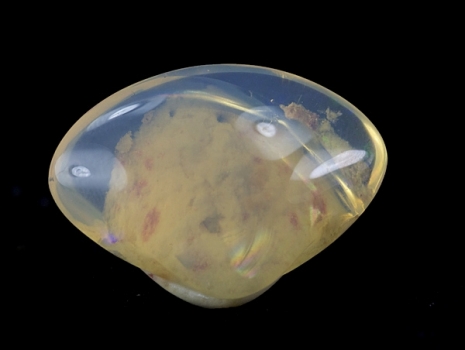
But I’m still weaving together bits of Kage’s old notes with new information: locating the bones with which to stiffen and enliven the softer flesh of dreams. What I’m hunting for is something like this:

opal clamThis is a clam. And it’s been turned to opal. Australia does that sort of thing.

The story will resume tomorrow, when I’ve assimilated, and collated, and cross-referenced, and interwoven more fact with more fantasy.

I’ll be hoping for opals.


Posted in Uncategorized | Tagged , , , | 4 Comments

Edges and Islands

Kage Baker never got to explore any of her story ideas for Australia.

She had ideas, though – lots of them. Let us explore  them, shall we? I’m trying something new with this entry, Dear Readers: and testing it on you. This is speculation, some new and some very old, on the history of Dr. Zeus in Australia – so I’m trying to set it down in a more literary style than usual. I want to see if I can tell you a story, and make it convincing.

thorn bar

So: Once upon a time (there you go, Buggybite),  the Company chose Australia for the first Company Base, due to the continent’s relative isolation well into the 17th Century. The Base was dedicated to raising future Operatives, and it needed generous amounts of space and privacy – setting it in Australia would provide both for a long, long time. And as the full activities of the Company grew firmer and wider, it was realized they would also need places with room to keep the armies of rescued plants, animals and even humans that they were collecting.

For most of human history, in fact, Australia was as isolated a place as one could get. The fact that so much of it is made up of wasteland helped, too: easier to clean up the traces than in Europe or the Americas.  Eurasia had traffic problems;  most Company bases would have to be disguised completely from their founding – lots of mountain fastnesses and underground redoubts; lots of mysterious cities in unmapped valleys. Hominids, you see, have been all over the Mideast and Asia since they walked out of Africa. Apparently everyone who ever hiked out turned right at the Nile Delta and struck out across the Sinai Peninsula.

A few followed the coast of the Mediterranean and ended up in Europe. The Company built its Bases there out on the Doggerland Plain (until it was flooded), and then under the Alps, knowing that the initial thin scattering of Neanderthals would get a lot worse when the Cro-magnons arrived. Along the  Eastern Med,  hominids wandered in and out of the Fertile Crescent for millenia, before discovering barley, beer and bread; also goats, and the many uses of mud. And there, the Company built Bases deep underground and high in the mountains, and hid the local field offices in pyramids and ziggurats.

Most humans, though, walked onto the Asian landmass, and stayed there – evolving, cross-breeding with subsequent emigrants, and in general leaving enough weird little civilizations all over that the Company had a veritable cornucopia of Event Shadows in which to operate. Not to mention incredible amounts of hominid one-offs and micro-populations to sample, store, and convert into Operatives.

And, of course, lots of folks and at least 2 species eventually headed out to the eastern edge of Asia; they stood there amid the hills edging India, Burma, Vietnam; Sumatra, Thailand, Java … and then they just kept walking East. Because when they did it, these late Homo erectus and early Homo sapiens, it was perfectly feasible – the Sunda Shelf was still above water, and what are now fabled islands were then even more fabulous highlands in a drowning land.

Look at any decent topographical map of South East Asia and the waters that edge it.  See how shallow the Andaman and China Seas are? See how all the islands are obviously the peaks of mountain ranges now under water? Well, they weren’t always. You could probably wade out for miles, following strings of marshy little islands to the tempting green sanctuaries of Malaysia, Bali, Borneo … or Flores. And once you got out into the real edges, where the water turned to blue and there was no sign but clouds of sea birds to hint at another horizon: well, by that time, you may well have figured out how to make a raft.

Some people did. They settled in Indonesia, in places like Papua New Guinea and the Philippines; those people still carry the traces of Denisovan DNA they picked up as they travelled through Eurasia. People reached the little island of Flores, but the earliest settlers weren’t Homo sapiens or any of their chance-conceived hybrids: they seem to have been Homo erectus, and most of them stayed right there. They stayed until the waters rose and the people shrank; elephants got small, rats got big, lizards got huge, and eventually bigger people arrived and the little folks – as they always do – drifted into obscurity in the hills.

The Company sampled them, stored them, and collected some of them. A small village (ha ha) throve for awhile under Company auspices; a few tiny children became specialty Operatives. Some of them ended up on assignment in Sumatra, shepherding the ROUS their ancestors had hunted on Flores, encouraging epidemiology and classical adventure stories.

In the meantime, some folks had reached the end of the island road in South East Asia. Along the Southern edges of places like Java and Timor and Papua New Guinea, the people observed that the birds flew south and then came back. They had to be landing somewhere … and once again, the peoples who had learned how not to drown tried their fortune on the sea. They came through the Torres Straight and the Timor Sea; maybe some of them had help from their gods, who would have been anxious that history turn out the way it was recorded …

Most of them were a unique population of Homo sapiens (eye colour, hair colour, bone structure), who had left Africa around 70,000 years ago – they had interbred with a few cousins along the way, but once they set out from Papua New Guinea, their bloodline would remain isolated for, oh, maybe 44.500 years. They did amazingly well, maintaining their culture for somewhere between 50,000 and 125,000 years: the oldest continuous human culture, on the longest held human habitation. The Company viewed them as a living library: not relict strains, but heirloom. An entire department of the Australian Base was dedicated to observing the Aboriginal cultural and physical development.

Possibly, some of them were also representatives of that old cousin, Homo erectus; they may have made their way over from Flores, through the Ashmore and Cartier Islands. Maybe those same anxious gods gave them a hand, too, or even a lift across the 800-odd miles of the Timor Sea. Someone would have had to make sure that their anomalous bones were eventually found in the Kow Swamp. Which they were …

Gods have to think of the little details like that.

thorn barCaveat: the foregoing is the intellectual property of Kathleen Bartholomew. http://atomic-temporary-14891989.wpcomstaging.com/                    materkb@gmail.com


Posted in Uncategorized | Tagged , | 6 Comments

Story Seeds

Kage Baker was fascinated by Australia.

Many people are. It’s an astonishing place from just about any angle of contemplation. Initially settled by a unique band of people, who chose a lifestyle quite unlike any other representatives of Homo sapiens. Home to thousands of animal and plant species found nowhere else in the world; possibly with the largest proportion of poisonous lifeforms in the world, including the only known poisonous monotreme. Edged by the largest construct ever raised by living beings; centered on the largest single stone in the world.  Rich in  minerals that are valuable, rare and/or radioactive.

Australia, yeah – it’s a hell of a place. Kage got a lot of lovely letters from the inhabitants, too, who appreciated her having Mendoza raised there. Kage admitted that she chose Australia because it was empty of nosy Europeans for a long, long time, and killed most people before it was finally, sort of, settled … plenty of time and room and Outback wherein to hide a Company Base and a constant tide of baby Operatives.

She always meant to write some stories about life at the Australia Base; she figured it had to be wild and wooly, if only because raising little super-intelligent cyborgs has to be a job that will turn even an immortal’s hair grey … I have various notes, not only from brain-storming sessions:  from her and from me, as well. It’s impossible to resist a fascination with Australia and its environs, especially in regard to its wild array of peculiar mammals and birds. I did lots of research for Kage. She took everything we found, ran it through the Rube Goldberg machine in her head (which science fiction writers rent as a franchise …), and produced Notes On Life In The Immortals’ Boarding School for me to read.

In Australia, the Company must have been able to keep and raise endangered animals on ranches – enormous, isolated ranches, where nowadays the Aussies raise sheep and cattle and horses. Many species were probably naturalized and simply turned loose – who’s to say why so many parrots live there, or how they got there, or why they didn’t survive anywhere else? Ditto for giant lizards – among them being the goanna, a giant monitor lizard that is technically extinct, but is still reportedly sighted from time to time. Surviving giant monitor lizards would also include the ones the Company eventually re-settled on Komodo, which is only about 820 miles from Casuarina (a nice beach city), in the Northern Territory.

From our notes on Casuarina … it’s named for the native casaurine trees, a species of not-quite conifers that grow fast, have good, hard wood, lower soil Ph, fix nitrogen, and produce a rosin that is edible to humans and turnip moths …  They’re a ferociously invasive plant elsewhere, as they exude compounds that can kill other plants (of course)  that don’t enjoy an acidic soil.  And that straight-line distance to Komodo Island? It also intersects one edge of Flores Island – home of the little hominins knows as Hobbits.

Those Hobbits are actually Homo floresiensis, a dwarf species of the Homo genus. There is evidence they are descended from Homo erectus, along a path none of the rest of us took. Interestingly enough, although it’s fairly well known when the Australian Aboriginals arrived in Australia – and when the British felons did, too – remains have been found of what appear to be quite another species. None other than Homo erectus – full sized ones. Kage thought they might have journeyed on from Flores, retaining their stature and eventually colonizing Australia: at least until the ancestors of the Homo sapiens Aboriginals got there.  Although the Aboriginal peoples seem to be very nice folks, the initial entry of Homo sapiens into a neighborhood always raises problems and lowers property values …

And of course, both groups would have donated kids to the Company. Kage really wanted to write about a Hobbit Operative, too.

There’s more in this particular vein. It’s coalesced from my restless wanderings through old notes and general weirdness lately; I’ve found amazing old stories, uncanny reports and weird ideas, and had a few more of my own. I think I’ll be speculating on this more tomorrow, Dear Readers – if anyone is at all interested?

Think about it.

Posted in Uncategorized | Tagged , , | 9 Comments

Black Cats and Blue Foxes

Kage Baker, as I mentioned a couple of days ago, was interested in some specific paranormal topics.  She would get intrigued for a week or so at a time, and idly pursue them while reading or Web surfing; then let it all go until the next time she needed a giggle, or a weird idea.

It was like making a fire with a Presto log instead of real wood. It’s cheap and fast and smells funny, but it gives off BTUs nonetheless.

I don’t know if it’s a similar low-energy curiosity rousing in my own drowsy mind, or the memory of conversations with Kage on the weird phenomena that get reported. But I’ve had a sort of junk-food craving for this kind of thing lately. I’ve found myself resurrecting old freaky sites Kage used to watch, usually late at night; I’ve been reading through some of the stranger books available on Amazon under (believe it or not) the “Science/Cosmology” heading.

Kage  was pretty picky about her sources, though. Too obvious a fake, a Photoshop or a mental aberration, and she turned up her nose. She said she wasn’t interested in knowing what kinds of craziness people came up with – she wanted to examine the incidents that maybe had a small element of Who knows? A certain amount of WTF was not unacceptable, and in fact added to the entertainment value. When people reported things that had apparently never, ever crossed their minds while sober and in daylight, the stories were more interesting.

She found the USA more than a little disappointing in this regard. While the USA is rife with weird phenomena – just this week, Bigfeet have been reported in Florida and Ohio, and UFOs have been sighted in the Midwest and New York – they are all much of a muchness. As noted previously, huge hairy primates are now seen across the entire US; even in the many, many states whose ecologies and landscapes wouldn’t be suitable for them if they were real. That disappointed Kage; she hoped for more imagination and less fadism in domestic hallucinations. No one’s been able to prove the Ivory-billed Woodpecker has survived, Kage argued, and they’re searching where it actually lived. Why are there 8-foot tall hominids reported coast to coast?

It showed a certain weak-mindedness, she felt, and a tendency to go along with fashion. Those shouldn’t apply in either science OR pseudoscience – although Kage did admit, fashions in apparitions did seem to follow the same patterns everywhere, at any given time. These days, people see and get abducted by aliens (always the same ones, too); 500 years ago or more, it was fairies doing it – but in the exact same circumstances. People marvel now over crop circles, and blame them on flying saucers and controlled plasma vortices: they were previously believed to be perpetrated by fairies and the Wild Hunt. Even Shakespeare blames them on Robin Goodfellow …

England still had the better stories, by Kage’s lights. The 20th and 21st centuries in the UK have been rich in weird sightings of everything imaginable: not just ghosts in ruined castles, which are really sort of passe these days. UFOs overfly the entire island of Great Britain as frequently as the trains run; and the majority of the world’s crop circles are reported from there. They show up constantly in those old, old fields, where the ploughman still follows boundaries that date back to the Neolithic … and maybe they’re not all being made by college students and old poachers.

Kage hoped so, anyway. In the meantime, crop circles are terrific art – so someone is doing the world a favour by producing them.

However, what Kage liked most of all were British Bigfoot sightings, and the constant reports of exotic beasts. She liked the Bigfoot reports because they were so obviously impossible – there is no place on the entire island of Britain, even including Wales and Scotland, that could harbour 8-foot tall hominids. Not even in the grungiest of council developments could they pass unnoticed; and where the hell could they have come from, anyway?

She felt that the sightings of Bigfoot in Moray or Yorkshire were unlikely enough; the Midlands and Kent were flat insane. It was likely that these apparitions were due to an emotional or spiritual source (an idea espoused by several paranormal “experts” in the UK); she was fascinated by what those could be. What makes people see otherwordly strangers in the first place?

The report of smaller than normal people throughout the UK, she dismissed as ordinary. People have been complaining about them since before the Romans. Kage suspected they were whoever the local indigenes were, sniping at the frequent invaders from the hills and moors.

For some reason, too, there is a huge body of reports of large, feral cats throughout Britain. Usually black; always larger than the average dog. They are reported most often from rural areas, especially those that breed sheep and cattle – which would be, if you wanted to find a logical place for escaped wild felines, the likeliest places. And the things have been seen – and occasionally shot – from Land’s End to John O’Groats, including Jersey and some of the Orkneys. It’s true that eccentric British collectors have kept private zoos for centuries; but there were still a lot of loose cats roaming round.  Why cats? Why black ones? And among non-black cats, what was a puma doing in Inverness? Or a leopard on the Isle of Wight? They fascinated Kage.

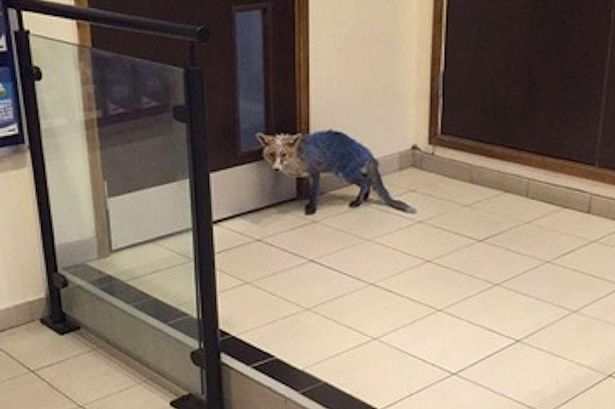
Recently, a blue fox was found in the lobby of a Travel Lodge in Woolwich, in SE London. It was lured out with Doritos, by a self-described “fox whisperer”. What worries me a bit is that, judging from the photo, this is the same sort of blue canid that we’ve been seeing in the American South West; the ones diagnosed as having “super-mange”. Now, the UK has one of the most stringent dog quarantine systems in the world – to prevent rabies and other doggie plagues from entering the island. So what’s going on with this poor blue fox?

If it’s mange, there’s a real problem. If it’s UFOs – well, I guess it’s no worse than chicken-eating leopards on Wight.

Kage would think so, I am sure.

Blue-Fox                                                Is it WOAD?


Posted in Uncategorized | Tagged , , | 2 Comments

Early Closing

Kage Baker, who wisely never kept any daily log whatsoever, could simply set aside her literary tasks when illness or ennui attacked. She actually did write nearly every day – but she didn’t consider it something she had to do, so it never felt like an obligation. It was just something that happened a lot.

Or so she claimed. I think it was true, because when she did have a specific writing job to finish, she wailed and whined about it. Though she met deadlines easily – and only missed one in her whole career – she moaned and complained whenever she had one. She just hated having that gun pointed at her temple.

Me, I rather like deadlines. I like writing in a white heat, racing against the clock or calendar or inevitable liquefaction of ice in sunlight. It gives an exhilarating frisson to the momentum of the work. Or, as Kage described it, I’m an adrenaline junky.

Could be, I suppose. It’s hard to tell these days, when I seem to spend my time caroming between illnesses. I am now fighting some strain of influenza for the second time this winter, despite having had the gummint-approved shot. The gummint lost the reins on immunization this year, apparently, and has admitted the official vaccine missed a couple of the strains now circulating.

I could tell them where to find them …

Anyway. My eyeballs feel like they’ve been deep fried, and all my muscles ache. I clearly have more muscles left in my old age than I had feared, because my arms and legs ache miserably … it’s either that, or my bones are cracking. Maybe I have dengue fever.

I’m sure I’d be catching measles, if I hadn’t had them at the 12th century plague level when I was 5. My sisters and I got measles so badly we all ended up with cast-iron immunity. The highlight of my case was when God took the roof off the house like the lid off a teapot, and said rude things about my suitability as one of His Son’s lambs. Rather put me off Christianity.

In the meantime, I am going back to bed.


Posted in Uncategorized | Tagged | 2 Comments

On The Fringes

Kage Baker was perpetually interested in a number of paranormal phenomena. They weren’t usually topics she researched for stories – she liked to deal with more firmly founded ideas for story sources – but some of the fuzzier, flakier and more fantastical pseudo-scientific areas intrigued her.

(Not ghosts. Ghosts are another thing entirely in our family. And that is a subject for another time, anyway.)

Cryptobiology was a favourite, because it had so frequently turned out to be about honest-to-gosh real animals. Kage was not as fascinated as I was by the tendency of human beings to eat cryptic animals, though; she was more in the horrified camp on that one. But she really got a kick out of following things like the endless search for Bigfoot all over America. She felt it was clearly a status object of mystery: damned near every state has found some reason to claim that a huge, mysterious, smelly quasi-hominid lives in its environs.

In the  (flat and largely unforested) Midwest, he’s mutated into Grassman – he lives on the prairie and in grain fields, and builds nests and lean-tos of the omnipresent grass. New York reports odd figures in Central Park, but also borrows from the New Jerseys Pine Barrens for Jersey Devils and ape men.  And Florida, evidently cursed with an embarrassment of riches, boasts Skunk Apes, werewolves and Reptile Men; not to mention whatever the endemic Homo sapiens get up to … cannibalism crops up in Florida at pretty regular intervals.

I was rarely interested in Kage’s research into this risible territory – because, frankly, a lot of it scared me silly. I don’t believe in shadow people, Bigfoot, or aliens of any colour; at least, I don’t believe I’m in danger of encountering any of them, on the extremely off-chance they exist. But hearing about them gives me the creeps. I revert to a completely un-judgemental childish state, operating on nerves and adrenaline; my eyelids glue themselves to my eyebrows and I leap convulsively into the air at every slight sound.

“If we ever see anything on the road,” I used to tell her gloomily, “I’ll be found dead of fear at the wheel. And I’ll have wet my pants first, too.”

“Don’t worry,” Kage assured me. “I’ll spill my Coke on you so no one will know.”

Which was weirdly comforting. But I still objected strenuously to discussing the various apparitions that interested her – I either went into a panic on the road (and we drove on back roads in the dark a lot – or I ended up sitting with the light on all night with a book on something absolutely canny. Like geology. The History of Granite never scared anybody.

But Kage only got more and more interested as she got older. She also got more and more skeptical, but I guess the amusement factor filled in where her disbelief scoured out what little gullibility she harboured. She found a weekly radio program run by and for ‘Squatchers (who are people who hunt sasquatches) and tuned in avidly in the last two years of her life.

“There’s a real phenomenon here,” she decided. “I think it’s a mental one, like mass hysteria or ergot poisoning: but it’s real. Flying saucers, lizard people, Bigfeet – the Hollow Hills, for pity’s sake! Why do these people all want so badly to believe these things?”

That was what really fascinated her. She herself believed in the popular myths so little that she made her own “aliens” a forgotten branch of humanity. But the urge to believe, the naked longing and determination of so many people to find the unseely in their own backyards moved Kage strongly. They all wanted so much to believe – why?

She was approaching a theory that it was the lack of spirituality in Western culture at the base of that hunger. Not just religious leanings – those don’t really seem to have slacked off even in these modern times. But most Americans, even though they belong to churches, don’t find the mysterious or the spiritual in their everyday lives. There is no magic in what they do – not even on Sundays, when they go sit indoors and listen to someone tell them what is wrong with the world.

Most people, Kage decided, don’t want anything more to be wrong with the world. They want to know there is something bigger out there, something that will change their lives.  And some of them, even in the 21st century, do as their ancestors did and go looking for it in the woods and the starry sky.

Kage wanted to know what they were finding. And how.

And … I must admit, so do I. Sort of. As long as I have a good flashlight to hand, and the dog isn’t growling at things I can’t see.

Who does go there?


Posted in Uncategorized | Tagged , , | 2 Comments

Ah, the Wonders of Science!

Kage Baker was a great fan of the wonders of science. She loved seeing what new techno toys were up and coming, what labour-saving devices were being developed. And she was just as entertained when modern science failed. I think it had something to do with watching the creative process in action.

Domestic robots fascinated her, although she felt we, specifically, were born to soon to see the full flowering of the industry. Programmable robots that fetch beer in their own ice chests are all very well – but no one has yet come up with a butler or bartender that makes complicated drinks. What Kage wanted was something that spoke in a George Sands accent and made perfect Manhattans – not R2D2 with a Budweiser in his head. Roombas fascinated her at first, but their programming did not allow for someone who kept stacks on books and manuscripts on the floor … and they degenerated into cat toys amazingly quickly.

“Smart” houses existed in her lifetime  (several paradigms’ worth, actually) but they all seemed to be exercises in DIY electronics repair. Circuit breakers were no more reliable than fuses. Wiring your refrigerator to your phone, your alarm system and living room lights was fun; but the results were more likely to be domestic fires and power failures than a lifestyle worthy of the Jetsons. And there was very little attention being given to any retro styles – Kage didn’t care for the cold, white, Modernne style most wired houses exhibited; she wanted wallpaper and wood panelling as well as ice and coffee in the fridge door.

Besides, as she always pointed out, never forget that the Carousel of Progress at Disneyland killed a cast member. Kage was not at all sure humanity was ready for that sort of power in intimate settings. And the closer the sex trade gets to mechanized intercourse, the surer she was that a whole new class of grotesque home accidents was on the horizon.

The behaviour of the Internet confirmed both Kage’s hopes and practical expectations. It was the magic crystal she had always wanted, letting her find and see almost anything from the comfort of her own desk. It was the enchanted portal she had been led to expect, too: webcams were a glorious surprise to Kage, allowing her to see exotic cities and faraway places. When other planets joined Machu Pichu and the London Eye on her daily viewing list, she felt that one techn0logy, at least, was achieving its promised goals.

“Ah, the wonders of science!” Kage would exclaim, gazing at the tidal mudflats of Titan.

Of course, she said the same thing when the lithium battery in my first cell phone exploded in a mass of hot foam. The difference was in the sarcastic role of the eyes …

Still, she loved techno toys, and was always eager to see what the new stuff was going to be. Not that she necessarily intended to let it into the house – that stuff was dangerous.

I don’t think I have the same intensely personal relationship Kage had with technology. I am inclined to be a second-wave adopter, maybe not waiting for the completely vetted version but not willing to be a beta tester, either. It’s why I’ve avoided Apple machines, because for all their virtues, there is no way to buy them without being a beta tester. I am saved from much despair, but I suppose I also miss a lot of stunning triumphs, too.

But then, unlike Kage, I’ve never been into dancing around the living room …

I don’t like surprise upgrades in my devices. I don’t let Windows, Norton or even SETI load upgrades without my checking what they do; Java and Adobe are always trying to sneak alien toolbars in with their upgrades, and must be watched constantly. I don’t assign personalities to the various faces of the Interwebs (I’m pretty sure Kage did) – but it can be personally annoying when my trusted connections get freaky.

WordPress, my blogging host, has been updating itself. Appearances, meh – who cares? But suddenly it’s hard to find the routes to certain functions, and all the alterations came without instructions or warning. Yestreday, in fact, I couldn’t get into the system at all – which spoiled my 2105 record to date. Today, I can get in but I really had to search for the button/link/synapse that led to my dashboard. And no, thank you, I do not want to learn a new system just when I sit down to compose …

Also, I seem to be coming down with an influenza. That will make the second time this year. And I had my flu shot, too – the CDC now admits that it may be only 20% effective, though, which means that 4 out of 5 strains now circulating may not be covered … and I seem to be catching them all.

The wonders of science, all right. Just as Kage always suspected.


Posted in Uncategorized | Tagged , | 2 Comments