Saturday, In A Cloud

Kage Baker liked grey Saturdays. Like so many people, she loved the excuse to sleep late on a morning when you basically can’t tell it is morning. She liked lolling about in her sweats, hair barely confined in a Gordian knot and a severely-stressed scrunchy, working her way gradually from a cup of coffee to a glass of Coke. Somewhere along the sugar gradient, her brain would presumably kick in.

Errands would be postponed. Meals would be re-arranged. A Saturday grey and late enough constitutes an urban survival test: you go and search the pantry shelves to see can be scavenged from what’s on hand. What are the supplies like? Chocolate, coffee, Coca-Cola, check; enough pasta to survive the Coming Zombie Apocalypse. We’re low on bread – but we have flour and yeast. Hell, we’ve got Bisquick, Parmesan flakes and Spice Islands Italian Seasoning – that’s a  pizza right there. Sort of.

The idea was to never get fully dressed or leave the house.

When we lived in Pismo Beach, the universal overcast-ness  gauge was the sea and how much you could see of it from the front room. Since it was two blocks away, the degree to which it was obscured was a great indicator. Was it visible at all, or did the town end on our side of Highway 1? Could you see dry sand, wet sand, or all the way to the breakers? The pier was about a quarter mile long – could you see the end or not? One developed a finely graded set of comparative measures.

In Los Angeles, where we lived for 40 years and where I now dwell again, the walls of the world close down on grey days. The clouds fill up the Basin from edge to edge. They  settle right down over the crests of the Hollywood Hills, so you can imagine the Crawling Eye up there amid the cell phone towers and fire roads. Visibility is determined by how deeply the canyons between are filled up with clouds, and how far down – because they fill up from the top, not the bottom. It’s not fog, it’s cloud; it creeps down the slopes and each receding fold in  the hills is thicker with vapor.

The lid of the sky is on tightly today near Griffith Park. The Basin is socked in, but only beginning about 10 stories up. The lower air is clear but it’s been twilight since the sun came up (If it did. We take it on faith, days like this.) and nothing extends more than a mile in any direction, including up. If you get close enough, you can see that the towers of Downtown ascend into encompassing cloud cover. But until you head a few miles south from here down the I-5, you can’t tell we have a Downtown at all. It might as well be the original pueblo down there, nothing taller than the sycamores along the zanja madre, the Mother Ditch we now call the Los Angeles River …

The clouds are beginning to nibble at the tops of the power lines, now. The cats and the Corgi come in wet from the drizzle coalescing on the roses. My brain is never going to come online at all, that much is clear. Time to go read some of Kage’s stories. And make some pizza.

Sort of.

Tomorrow: Sunday, usually.
Posted in Excuses | 2 Comments

How To Dream

Kage Baker was a firm believer in dreams. Not in symbolism or hidden  meanings – she took dreams pretty literally, assuming her sleeping mind had something to say to her. She listened.

She also assumed her mind meant what it said pretty directly. Rather than dreaming of snakes and realizing her unconscious was being coy about benzene rings (look up Friedrich August Kekulé), Kage would dream she was trying to catch a bus to Catalina Island – and decide it meant she needed to go there. Which she did, and which we did, and which ultimately resulted not only in years of mad fun but several major plot points in The Company series.

She would dream of eating in some cafe of the Children of the Sunand spend a weekend reproducing the dishes she had eaten (Tangerine & Scallion Sirloin, Caravan Bandit Style was one of the more notable successes.) Or she’d dream of some specific weird vista, and we would spend days driving around trying to find it – because she was sure she had  actually seen it before. About 90% of the time she was right, too. One of our favourite camping places in our 30’s and 40’s was a beach she had not seen since the age of 7 – and guided us to unerringly by landmarks decades old. Conversely, she would set scenes in places she had imagined, and then we would have to find the best possible match in real life; which is why Budu is buried in Chinatown.

Kage believed that most of the images in her dream were just static – but, like images in clouds, they could be made to mean something. Sometimes she would dream a place or a person or a thing, and file it away until she came up with the story that was the perfect setting. Joseph performing DIY surgery on his shoulder (In The Garden of Iden) was an isolated image in a nightmare; so were the icthyosaurs that crop up over and over.

What Kage longed for was to dream lucidly. She imagined it as the best video tape ever, where one could direct the plot of dreams so sleep was really useful and fulfilling. She studied it – there are books that give directions to lucid dreaming. But no matter how disciplined she was, what regimen of handy notebooks and alarms she set, she never managed to do it.

So then she studied me, because I can and do dream lucidly and had told her about it for years. For most a year, with grim determination, she would lead me through bedtime scenarios to see if my mind would adopt the plots. She’d wake me up at the first sign of REM or subvocal mutterings and demand to know what I was dreaming …I sometimes wonder uneasily now if the programs I access most frequently on this computer mind the constant interruptions.

Kage was, as ever, determined and disciplined in her research. Unfortunately, I apparently spend most of my dream time in a stoned condition; because while I can direct my dreams, the logic I use for what seems reasonable is … questionable. Realizing I am dreaming, I can sieze the plot – but I am far more likely to decide the car needs chocolate wings than to import William Shakespeare for advice on a writing project. And this makes sense at the time … even I think this is a waste of a great resource. If my dream-decisions made better sense, I would have spent a lot more time having sex with Sean Connery.

But I finally realized why Kage could not train her excellent mind to dream lucidly. It was because she already spent all her waking hours doing it.

A writer may try to plot out a story in logical steps, via graphs and flow charts and colour-coded notes (the flow chart for Iden was 22 feet long and went around two walls of the spare bedroom.) And often this works; especially for keeping lists of characters’ names straight and choreographing battles. But a great deal of what creates the story is happening deeper in the mind, and only emerges into words through the moving fingers. I think it’s why authors are so often surprised at where their story goes –  they are dreaming and have no more idea of what the dream is than anyone else. It only becomes a lucid dream when they begin to write it down …

This was cold comfort to Kage. She’d sigh and observe that – just now and again – she too would like to settle into the story and have someone else tell it. She got tired of doing all the work. She’d really have enjoyed effortlessly skimming along in one of her tales, rather than keeping the sails trimmed and the glass turned, and her tired hands on the wheel.

And if I accomplish nothing else at all with what she left me, I hope I turn out something she can enjoy. Somewhere. Somehow. In her sleep.

Tomorrow: Saturday!

Posted in Uncategorized | Leave a comment

Autumn Flames

Kage Baker was a fire-chaser. A rather timid one – she’d jump up and crane out the window when fire engines sounded in the streets, complaining if she couldn’t see where they were going. If they came to a stop anywhere near – with that flat run-down WHA-wha of the siren that means they’ve stopped – she’d dash out to see if she could catch a glimpse without actually getting in the way.

She was very good about that – not getting in the way. But if she could get near enough to see the smoke and flames, she was tremendously pleased. As long as no one was getting hurt, nor losing their house, or car, or … what she liked were neatly contained brushfires, I guess, with viewing areas.

You don’t get a lot of those in California. Though we found a few over the years: there was a small fire up near Jade Cove on Highway 1 once, where we sat and watched the action, having already been stopped in the rest area for a picnic when the hillside began to smoke. Kage shared her Coke with the Fire Captain.

And we drove through a few passes actively burning on various highways – Gaviota Pass on Highway 1, the ever-surprising Grapevine on the 5, the long curve from the 5 to the 580 in Altamont, where you enter the Forest of Wind Turbines. Now, that’s an amazing sight, with flames licking knee-high through the yellow grasses all around the tall, humming turbines: really strange smoke patterns.

Gaviota and the Grapevine were especially thrilling, as the way is narrow and the fire was getting pretty familiar with the road – but traffic was getting through, so we rolled up the windows and drove like mad under the arching banners of living flame …

The hardest part was keeping Kage from rolling down the window and hanging out the window like an ecstatic hound. She wanted to stop and stare. Especially when we passed views like a hillside of wild ivy, every leaf a separate perfect shape of fire, a curtain waving in the wind of its own combustion. Or an oak tree, thick with green leaves and acorns on one side, engulfed in golden flames on the other.

“It’s the freaking hand of God!” Kage would wail, pressed up against the window. “Come on, just slow down!”

“You said you didn’t want to learn to drive because I have better judgment,” I would remind her, edging our speed over 80.

“Oh, screw you, you Philistine!”

Lest you think Kage Baker was a barely compensated pyromaniac (though I can just see our sisters and friends nodding in agreement …), she never started fires. She just was tremendously moved to see them. Even a glimpse of an agricultural fire beside the highway – the column of white smoke twisting against the orderly ploughed fields, the glassy transparent flames all unreal at the base, the solemn silhoetted figures around it – would make her point and smile. For Kage, seeing a fire was a glimpse of a familiar wild animal. Just like sighting an eagle, or a deer, or – once and surreal – an iguana crawling unhappily along the verge in Griffith Park (he was an escapee, soon returned to his anxious master): it delighted her to catch sight of it.

It was, I think, an echo of the furnace always blazing in her own skull. When an erudite and patient friend, Stacy Weinberger, gave me a copy of Tom Cowan’s work A Fire In the Head: Shamanism and the Celtic Spirit, I recognized the condition. It was what lit up Kage’s eyes like the candle in a jack o’lantern; it was the voice of the flames that called her always.

Tomorrow: Samhain is a’coming and the barley’s getting fat

Posted in Excuses | 10 Comments

At Liberty In The Park

Kage Baker went to Immaculate Heart High School, at the intersection of Western and Franklin Avenues in Hollywood. The dear old pile – which bore a strong resemblance to Ghormanghast when Kage and I (and a couple other of our sisters as well) went there – stands just on the curve where Western  segues into Los Feliz Boulevard. If you  walked up Western there, past what once was Immaculate Heart College and is now the American Film Institute,  and past the inexplicable bronze bust of Lief Erickson, you came within a quarter of a mile or so to Ferndell Drive: the westernmost entrance to Griffith Park.

A quick left and you were in under the Scotch pines and invisible from the street or either campus. You were at large in the Park then. You had successfully ditched school and escaped into the Wood Outside Athens.

This was something seniors, privileged to leave campus, often did. The rest of the student body did it, too, but with greater caution. Only the seniors could safely sunbathe on the lawns fronting Los Feliz (doubtless causing numerous car accidents), because if someone from the college saw you out there, you’d get turned in. Most girls therefore lurked up under the trees. But Kage and I used to climb up to the Observatory.

There’s a little cafe up there (where we sometimes could afford Cokes) and the Nature Museum. That Nature Museum had the weirdest dioramas ever. Truly strange. Little dinosaurs wagged their paper-clipped-on heads, little cavemen shook their toothpick spears, and a little volcano belched cotton wool lava, lit from below by a clearly visible red Christmas bulb … Kage loved those things. Even in high school, when we’d ditched afternoon classes to escape up there, she’d stand in front of them and press the buttons over and over, laughing harder each time.

“It’s all true,” she chortle, watching the sullen red cotton clouds lighting up over a miniature Ferndell. “This is the real world. It’s all a big crafts project by 4th graders!”

When she could be dragged away from existential hilarity, we’d head further up the canyon. If you turned right at the Ferndell Picnic Grounds and headed straight to the back, you’d come to where the creek that ran through the park originated; and behind the muddy far edge, a trail went up the hillside to the East.

I don’t even remember how long the walk took. The last time I took it, I was 17 – lithe and young and as dumb as the squirrels in the oak trees, doubtless risking my academic standing and my life by hiking alone in the hills. But I was young and dumb and thus was preserved by Fate to look back on the antics of 1971 and shake my head in wonder.

Most of the time I was in company, anyway, and at the first strange sound we would abandon the trail and run up the hillside like startled does. Once between the trees you were essentially invisible, and could just keep on going to the next loop of the trail. You could cut off a lot of slogging, and also avoid the serial killers and Park Rangers we were sure were on our track.

We never actually saw anything. We used to hear a flute playing sometimes; but we never saw who was playing it, or if he had shaggy legs and goat horns …

Ultimately, one came to the Observatory grounds and could collapse on the cool green lawns, in the shade of the astronomers’ monolithic statues. There’s a snack stand up there, too; but if we had no money – and we usually didn’t – there were water fountains inside the marble haven of the Main Hall. And the steps and terraces had endless shady angles, places to sprawl on cool stone and discuss all the worlds inside Kage’s head. Also whether or not calling a parent would get us picked up at the Observatory (with some excuse about a field trip, maybe?) or if we’d better hike back down before the mountain lions and dire wolves came out.

I am old and fat now, and most certainly no longer part of that cloud of brainless nymphs who ran up the hillsides 40 years ago. But now I have a car! So I am going to drive up to Ferndell. I can afford a soda now, and I’ll see if the dioramas have improved.

Then I’ll drive on up to the Observatory, and lean over the edge of that long hot trail, and listen for the flute …

Tomorrow: fire season, in LA and Kage’s head

Posted in Uncategorized | 1 Comment

Not Today

Kage Baker is not with me today. No faintest hint of her – not though I crank up her favourite music, or stare desperately through all the palantiri on the desktop.

I think she’s out roaming the October hills. There’s a high warm haze today, not quite smog but thick enough to render all distance imaginary; she liked that weather. It always meant Halloween in Los Angeles. She liked to crush the big brown sycamore leaves in her hands, for the sweet dusty perfume they gave off. Occasionally she’d get a lungful of it and cough her brains out, croaking “Smoooooth, man,” while I pounded her on the back.

Nothing seems to be on fire (yet) but there are fire engines wailing all around the neighborhood – one just pulled a U-turn at the nearby intersection, almost T-boning its own trailing ambulance – and so Kage may be out chasing them, as well. She liked a good fire. Or an amusing public services vehicle accident.

She sure wouldn’t want to be here this morning. The Corgi is gone quite out of his little mind with all the fire engines, and is zooming back and forth through the house and yard, barking incessantly. That sets off the beagles down the street, and they sound like they’re being fed into a wood chipper. There’s nothing wrong with them, excited beagles always sound like they are being dismembered.

Harry the Parrot was upset by all the to-do and insisted on sitting on my shoulder – however, he decided that being inside his nighttime cage would be best in this unsettled atmosphere, so he rappelled down my hair and marched off across my bed to climb into his perch. But my desk and chair are set at the foot of my bed, where the little black cat is sleeping: or was, until Harry marched across her tummy on his way to his cage. Now she’s lying there meowing with shock, pawing at the air like she’s drowning, clearly confused by whatever the hell just walked across her. She’s never quite figured out what Harry is.

My notes make no sense. I had a great idea when I woke up this morning, but it vanished somewhere in the morning chaos of taking my nephew to Cal State LA (unnatural child, he’s never learned to drive). All I can remember is something to do with Better Cheddar Crackers, but I suspect that was a dream and not some plot adjustment to Nell Gwynne II.

My coffee is cold but I am drinking it anyway. Google Earth has vanished off my computer. My earrings keep falling out. It is obviously a day dedicated to minor torments.

And since Kage’s spirit has decided to take French Leave and go walking in the hills, I’m gonna follow her. Maybe I can catch up before she inhales another sycamore leaf.

Tomorrow: how good girls cut school

Posted in Excuses | 4 Comments

The Temple in the Hills

Kage Baker loved the Griffith park Observatory. So did I, and still do.

Kage was always fascinated with its classical beauty and weird exhibits, and the mere fact that it is there in the first place. One doesn’t readily consider the Los Angeles Basin when one thinks of celestial observation. Mount Wilson, now, so remote in the California mountains that the road washes out every rainy season; or Arecibo in its jungle valley with parrots flying through the very eyesocket of the telescope … those, yes. But not the Griffith Park domes, silhoetted against the sea of lights that stretches below it, West to the Pacific.

I suspect most Angelenos don’t think about it much, even though it’s perched up there on the  hills of Griffith Park. You can see it from as far away as downtown, Century City and the Baldwin Hills, gleaming like a pearl. The fact that there is a world-class observatory in Los Angeles doesn’t seem to surprise any of the natives … but it’s astonishing, really. Does anyone wonder what it can see? Does anyone wonder that it can see at all? To anyone who notices it, it’s a commonplace miracle.

Growing up as we did on the edges of Griffith Park, the Observatory was a fixture of life. Hell, you could see it from the front yard! I’m in a different front yard now, but it’s the same neighborhood and I can look up to that temple on the hilltops every day.

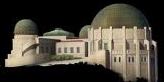
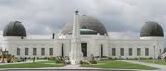
Saturday I spent several happy hours exploring it after an absence of 16 years, and it was as beautiful as ever. It’s just completed a major renovation, to celebrate it’s 75th anniversary and unlikely survival in this light-soaked wilderness. The old halls are tidied, the Focault Pendulum and Tesla Coil and Camera Obscura still where they always were; the seats are more comfortable in the theatre, but the new Zeiss Projector still rises like a giant mechanical ant from the floor there.  Under the whole thing, though, an entire new floor has been excavated, and new wonders wait down there like the caves of Lascaux.

The stone walls are now immaculate and white, and the bronzed roofs of the telescope domes have been cleaned and stabilized. All the corrosion and verdigris is gone, and they are expected to stay bronze-coloured now for decades.

I rather regret that last bit.

When we were small, the domes were a glowing sea-green above ivory walls, and the Observatory looked even more lovely and exotic than it is. It looked like a sea-king’s palace, the last bastion of Lemuria still watching over the remains of vast cities sunken beneath the western waves. When we were 14 and 15, we decided it looked like Minas Tirith; and if you are looking up through the golden afternoon haze and ranks of oaks on the hillsides, it does.

When I was very small, they kept a meteorite in one of the side halls – in those more innocent days, just sitting there on a plinth. You could climb on it (I don’t know if it was actually allowed, but you could do it) and, being small girls, we did. I got a sneaker stuck in one of the holes in it once, and had to leap down barefooted and wiggle it out before a guard noticed.

This time, I touched a piece of Mars. It wasn’t there when I was a kid – it’s a shard of one of the Martian meteorites we have found in the last few years. It’s a tiny bit of ruddy stone,like a chip off a terra-cotta tile: but it’s not a tile, and it is most certainly not terra anything.

It’s Mars. In the hills above Los Angeles, in that temple of sea kings and childhood dreams: Mars.


Seven stars and seven stones and one white tree


Minas Tirith


Tomorrow: running loose in Griffith Park

Posted in Uncategorized | 2 Comments

The Hot Heart of Mars

Kage Baker liked writing about Mars. That surprised her when she started it.

I mention this because yestreday I touched a Martian meteorite, at the Griffith Park Observatory. It had been upwelling lava from under the skin on Mars; now it is warm red stone, the colour of Kage’s hair.

Mars had not been a particular interest of Kage’s when we were kids, although her favourite Bradbury stories were those about Mars. It may have been the autumnal beauty of the dying Martian civilization that appealed to her, or even just the image of floating down the Grand Canal with one’s lover on a distant Martian night. But it was a mild interest to start with, and nothing much inspired her about the Red Planet.

Until we started losing spacecraft up there. That fascinated her. None of her ideas about what was eating them made it into stories (I have the notes, though); instead, she got interested in Mars As The Frontier. Mars With People On It. How Will We Live On Mars? turned out to be the real draw for Kage. She could never resist the exploration of human nature.

She figured no one would actually make it to Mars unless they saw a way to make money from it. And  life on Mars would initially be fairly desperate. There’s a brief glimpse of the grim, humourless Collective when the feckless Alex Checkerfield delivers guns to Mars in The Life of the World to Come: a cold, politically aggressive society, closed in on itself in a kind of Neo-Puritan righteousness. After she wrote that, though, Kage felt guilty about the charmless world she had implied, so she added Mars 2 as a cosmopolitan balance to the deadly earnest agrarians. Though neither societies were sketched in much detail, they were set on clear contrast to one another. And Kage had a detailed conflict pictured in her mind.

Then, of course, she blew them up.

The bomb in the arethermal energy plant on the slopes of Olympic Mons blows a literal hole in Mars 2 (It was not a volcanic eruption. All you people who complain about that, go back and read that part again, please). Then Kage felt even guiltier about what she’d done, so she wrote The Empress of Mars to explain how Mars 2 got there in the first place.

Empress was one of those stories that got away from her. It went where it wanted, places Kage didn’t expect – she was as surprised as anyone else at what happened. And when Tor Books asked her to expand the original novella into a novel, that held even more surprises.

The main one was that it was due 6 months earlier than she had thought it was, and she simply forgot to write it. On making this discovery (and once the screaming and throwing things had stopped) she sat down and carefully interwove another plot and a half into the story. She did it in 6 weeks. It was one of those stories where she kept asking “What happens next?” and I would moan and make silly suggestions and gnaw on my knitting until she finally said, “Oh, I know!” and got back to supplying the Tharsis Bulge with Painless Dentistry and A Fine Assortment of Recreational Pharmaceuticals.

Kage still felt bad about blowing it up, though. And even though she rid the Martian Collective of its evil corporate overlords, she also pretty much abandoned the colony on Mars. So she wrote some stories about it – about children, as children are any societies’ future: “Where The Golden Apples Grow” (Escape From Earth, paperback from Firebird, 2008), and the forthcoming “Attlee and The Long Walk” (from Jonathon Strahan, in Life On Mars, due out in April 2011 from Viking).

More, she outlined much of What Happens Next. She meant for Mars 2 to rise again, for the Long Fields to continue and for Mary’s bloodline to go on.  I could feel that future like a pulse in the red stone under my hand yestreday. And so – I guess it will.

Tomorrow: the Observatory

Posted in Uncategorized | 3 Comments

October 9th

Kage Baker loved the Beatles. Really, honestly loved them; madlydeeplytruely. Not carnally – except for George; George was IT as far as Kage was concerned – but with the religious fervor of one who has assigned faces to the 4 Evangelists.

She was 12 in 1964, and always considered it the Perfect Year. Maybe not the best year of her life, nor the happiest, nor the most productive: but it was Perfect. That year, 1964, was perpetual summer, pure gold with the voices and faces of the Beatles everywhere; for the rest of her life, one tattered calendar in the house was just recycled over and over through 1964 (and every few years, it made sense, too. I took it down for the last time in February … ).  I think, for the first time in her life, Kage solidified her personal image of Divinity in 1964.

Not the Beatles per se, no – they held status more at the level of archangels or Bodhisattva. But the idea that God has a face,  a man’s face, a mask that one can gaze upon and love and interact with: that was born that summer, powered by the perfectly normal 12-year old lust she shared with millions of other little girls. Most of those millions wept and had cathartic hysterics, had their tastes in men and music affected for life – and then went on to  ordinary lives enriched by the experience of adoring John Lennon or Paul McCartney as their mothers had adored Frank Sinatra. It’s part of being a 12-year old girl, I think.

In Kage’s mind, though – something sparked, flared, and divided into 4 fountains of flame that never ceased. For a couple of years, she poured part of her creativity into a sort of secular theology. The world was divided into quarters, each of which was personified into an Aspect. Each Aspect bore a face and a voice and a character. Seasons; elements; virtues and sins; weather and condiments: she assigned “George” skies, “Paul” drinks, “Ringo” dawns. “John” moods.

John was the Angel with the flaming sword; he was Justice and Law. He was high noon, a bright-tiled altar in sunlight on a hill covered with sunflowers and red roses, a thousand dancers in a ring on a field of gold. He was also violence, madness, and fury. He was glee and all passions, coloured glass and broken glass and molten glass. He was Horus and Gawaine and Shiva.

Today, October 9th, was John Lennon’s birthday. He would have been 70 – which is in itself absurd, John would never have been so old! The world remembers and honors him today; he is the world’s passion and has been now for half a century. Which situation would, I fondly believe, have rather made him laugh …

Kage would have laughed. But she’d have approved too, even as she saw the delicious absurdity of the world solemnly canonizing John Lennon the same way she did when she 12 years old. He was worthy of it, after all – the worship and the absurdity both. And Kage knew, we need masks to approach God, we need to look in human eyes in order to survive the gaze of Divinity; we need people who can stand the divine fire long enough to let us see it burn in them.

So, happy birthday, Johnny. Wherever you are. In your honor, according to the old rites, I’ll drink whiskey and stare into the sun today.

Posted in Uncategorized | 2 Comments

The Road of Excess Leads To The Palace of Wisdom

Kage Baker thought that famous statement was largely a cop-out. She saw it as a teenager’s excuse for a natural lack of discipline, claiming a pious moral evolution long afterwards, when he could no longer traverse that Road of Excess anyway.

“Of course, the Road of Excess leads to the Palace of Wisdom,” she’d snort. “You get tired, don’t you? You only get points for it if you turn off before you’re too old and fat to be wicked anymore!”

Kage herself was by nature abstemious. Physically, anyway. She rarely over-indulged in corporeal excess, tending more toward quality than quantity. For instance, she drank soda by choice: but only certain sodas. Usually a Coca-Cola product. And she would not drink anything else – no compromises for Kage. She would simply, quietly, stubbornly do without if she could not get exactly what she wanted.

Also, she tended toward a disciplined sort of OCD behaviour, wherein she would identify precisely a food or drink or location or activity that promoted contentment, and stick to it with single-minded focus. She could happily eat the same meal for days on end, once the craving took her. She never listened to an album only once: it was over and over and over, usually for a couple of weeks. (It was apparently hereditary – Mamma got evicted from an apartment in her young womanhood for listening to The 1812 Overture all day every day for a couple of week. My sympathies are with the landlord …)

Kage, as is well known, was very fond of chocolate. But she was not a binger, despite some hilarious scenes of theobromos overdoses written into her Company novels. No, I’m the one who has actually worked her way through an entire Pound Plus Belgian Chocolate Bar from TJ’s in a single encounter … Kage could make your standard Hershey bar last a week, eating one square at a time with total emotional commitment. A box of See’s candy at Christmas never saw the New Year with me; Kage usually ate her last Scotchmallow on Candlemas – slowly, prissily, while I rolled around on the floor howling with envy.

Part of her habits were due to a profound dislike of change. As she said, that’s what habits are for: so you know what you like and how to do it and how not to waste time messing around with things you don’t enjoy. So once she knew she liked something, she stuck to it. She was aware that getting cranky if we missed a vista she enjoyed because I turned right a block early on the way home was, yes, indicative of obsessive behaviour. But she didn’t care much. Kage saw nothing essentially wrong with obsessive behaviour, as long as it wasn’t making trouble for someone else.

If I needed to skip part of an habitual route so we could get to work on time, she never complained. But if it didn’t matter, she preferred me to take the route she was expecting, the one she was anticipating, the way she was almost already on before I made each turn: because it was engrained on her nervous system. “Don’t mess with my engrams,” she would say, “all my neurons need to do this. Turn left or my head will explode.”

“Oh, come on, let’s live a little. Let’s go past someone else’s garden today.”

“Okay. Okay. I’ll just sit here and twitch, then,” which she would promptly do with great grotesquerie.

“Oh, screw you!” I would yell. But I usually turned left.

And you know what? There would be a rare bird in that garden as we passed, or a $20 bill would blow in the car window, or a hideous accident would occur where we would have been if we hadn’t proceeded according to Kage’s obsessiveness. Which is why I usually turned left.

And that’s most of the other reason she stuck to her habits, right down to the weird little details: they worked. Good things happened. If she followed the routes, the rites, the routines worked out by trial and error and sanctified by repetition, she didn’t have to waste as much time. She could go straight to the still perfect center where she could think and work and write. The place where miracles happened. So her road of excess and obsession did indeed lead to a palace.

That’s the one thing Kage always did indulge in – the writing. Her work. The work. Because, you know, nothing really matters.

Except the work.

Tomorrow: is John Lennon’s Birthday.

Posted in Uncategorized | Leave a comment

More Fruits of Research: DIY Cyborgery

Kage Baker was fascinated by the idea of being a cyborg. There was a certain element of horror to it – she had nightmares when she was young, of discovering complicated gears and levers beneath her own skin – but it was a bright-eyed horror, the sort that keeps you staring at the scary movie or standing in line for the haunted house.

When she was little it was mostly a fondness for clockwork automata – The Tick Tock Man of Oz was one of her favourites of that series of books (yes, there is more than one Oz book. Lots of them, in fact. Look them up.) Her interest graduated to famous, professional automata like the Chess Player (was he real or fake?) and the Digesting Duck (charmingly vulgar), and the various and sundry handwriting machines. That latter category varied from skeletal hands holding pens to lifesized young ladies writing out elegant invitations once wound up: but they all ran by clockwork.

Until she discovered the Internet, her research was of course conducted via the library. There are lots of good books on automata, although only in recent years have they gone back far enough to resurrect the amazing work of Heron of Alexandria. But the machinations (ha!) of Al-Jazari (The Book of Knowledge of Ingenious Mechanical Devices, 1206 AD), and Villard de Honnecourt (14th century France) were known, along with all the elegant 18th and 19th automata that entertained the Crowned Heads and music hall audiences of Europe.

And of course, there was that Ultimate Artificer, Leonardo da Vinci. Kage got a facsimile copy of his notebooks, in several volumes, in her early 20’s, and practically worshiped them. Along with the tanks and wings and odometers, he designed automata; even the Great Horse was originally designed to be animated. Probably. The details are hard to make out.

And then the Internet blossomed, and Kage did her very best to become a cyborg via modem herself: as so many of us did, when first introduced to that endless and endlessly growing flood of information. Why be content with scholarly analysis from St. Martin’s Press, when you could find original and marvelously exploitative vaudeville posters scanned into some other fanatic’s website? Original sources, man! Complete with what the contemporary adman thought was scientific copy and technical drawing!

So a search for the classic Turkish Chess Player could now lead to a discussion of use of dwarves in automata, and then to the proliferation of dwarfed and crippled smith-gods who built robots (Lots of them. Very strange.) and then to the fact that Tolkien’s origin for the dwarves in Middle Earth was as robotic servants to a child-hungry Valar. A search for the Digesting Duck (a machine apparently designed by someone with a first-class brain and the aesthetics of a 4-year old) led to Ducky Doodles (a modern vaudeville horror rightly kicked off the Johnny Carson Show).

In fact, Kage’s original vision of the Operatives of Dr. Zeus  involved clockwork; I think she was on the verge of developing some version of steampunk years ahead of schedule when she discovered nanomechanics. Then she could design her clockwork on a molecular level, and her cyborgs got a lot more elegant and easily disguised. On the other hand, the world was deprived of the vision of literal steam venting out of Joseph’s ears when he lost his temper …

She was finally able to indulge her fondness for really complicated automata with the short story “Oh, False Young Man!”. The hero there is a machine so exquisitely made that he is superior to a flesh and blood lover, and wins a rich and lovely bride by virtue of his, mmmm, customized physiology …

Which you can also find on the Internet. Look up old medical automata. There are some amazing things out there.

Tomorrow: maybe more cyborgery

Posted in Uncategorized | 2 Comments