First Monday in Autumn and It’s 104

Kage Baker loved heat. That is, she preferred to be warm rather than cold – but there was an undeniable element of the salamander in her, too. She was perfectly happy when the temperature got into the 90’s; fewer clothes, more cold Coke, and turning on her big Art Deco floor fan kept her happy as could be. (And a killer fan it is, too – the base and staff and blades are all worked like palm leaves. Nifty.)

This, despite the fact that she could get a sunburn sitting too close to the living room window on a clear day: she was thoroughly a redhead, her skin was like photoreactive porcelain. She kept waiting for the freckles to run together and give her a tan, but it never happened. I made her wear industrial-strength sunscreen through our Faire days, but she hated the stuff –  she relied more on broad brimmed hats and wimples when in costume.

Right now, Los Angeles is in the midst of its annual autumnal heat wave.  Yestreday got up to 105 here where I live on the edge of Griffith Park; it  could get as high as 110 today. The newspapers and news programs are all hysterical about the deadly heat; one would think that global warming is bearing down on the city gates like all 4 horsemen of the Apocalypse, riding a flaming Harley and spraying CFCs with both hands.

It’s another confusion of seasonal weather with global climate change. The weather always turns hot in September, and we often roast here in LA for Halloween. Kage’s theory was that it was the atmospheric effect of all the wool – because the heat wave started as soon as all the kids went back to school. Being Catholic school kids, we went dressed in navy blue and plaid wool, and regularly keeled over in the playground. The nuns advised us to offer it up to Jesus and the odor of sanctity became permanently confused in my mind with kid-sweat.

Lemonade was our afternoon tipple of choice back then: maybe with a drop or two of almond flavouring, and definitely with food colour. Green, blue, red, a startling vermillion – we drank it every colour of the rainbow except the way it was made. In parrot-coloured aluminum tumblers. It tasted colder that way.

In her maturity, Kage preferred mai tais, and rum and Coke, or gin and tonics if she was feeling like practicing austerities. Though even then, she liked an umbrella and a fruit spear and maybe a neon monkey in her cocktail as well … there were several scorching autumns when we all went nuts for Pimm’s Cups, served in Momma’s surviving crystal highball glasses, out in the backyard where the eucalyptus trees dropped leaves like red fish in all our drinks.

Good memories. And my memory tells me as well that this heat wave is  – if not normal – at least seasonal. It’s been a feature of autumn in Los Angeles for the 57 years of my life, so it has to have some vague connection to normalcy, right? And every year, the news announcers jump and down all aghast, reporting in disbelief that IT’S OVER 100 DEGREES IN LOS ANGELES!!!

Yeah, we know. It was last year, too. And in 1954, when I learned to walk and discovered how hot sidewalks can be for bare feet. And in 1958 when I started school, and 1969 when we landed on the moon, and 2000 when the media though the new millenium had come and in 2001 when it actually did. And it’s hot now – it’s 108 now, to be precise, and even if it didn’t do this every freaking year, you know what? We’d notice this. We really would.

So chill, news media. Have a nice cold cocktail with a green plastic monkey in it.

Tomorrow: plot carpentry, maybe
Posted in Uncategorized | 4 Comments

Religion

Kage Baker loved God. She was a  pious lady, and always considered herself a Christian, and she liked a well-done ritual. So being raised in the Roman Catholic Church with all its pre-Vatican II panoply, was very satisfying to her in her youth. But when Mother Church started to get menopausal in the 1960’s, and then downright flaky as the millenium wore on, Kage quietly withdrew to a more private colloquy with her God.

She never did trust large organizations very much.

While she felt she had received a superior education in the Roman Catholic schools we attended, she was always a little leery of the spiritual indoctrination we were taught along with the geography and New Math. She wanted to arrive at her spiritual convictions under her own power, and not because someone had handed her religion on the same emotional plate as the multiplication tables. She never really trusted organized religion, either – anybody’s. One can have faith in God without having any in the Pope or the Magisterium. By nature, I think she was better suited to an older age; she could have been an anchorite with no great difficulty.

In fact, Kage did her best to achieve a sort of St. Julian of Norwhich lifestyle in her later years, dispensing advice and her observations on the Universe from the privacy of her cell. I was the one who went out and foraged, bringing back news and groceries and the things I had seen as I went about in the world. We used to joke that I was her raven. Or whatever it was that fed old St. Anthony and the other hard-core anchorites and stylites; Kage thought St. Julian had had much the more sensible idea, cozily sequestered in her furnished cell. And of course, Kage had a whole flock of Huginns and Muninns at her command on the Internet.

She had no trouble with the various superstitions, elder religions, re-purposed goddesses and faeries with which society is rife (and always has been. Gods don’t go away; they re-train.) and was herself pretty comfortably superstitious. Why not? She said it was not the place of mortal woman to decide what God did or did not find significant; for all she, Kage, knew it would indeed induce cracks in the fabric of the Universe if she let me throw my hat on the bed.

Maybe that was a joke. Maybe she meant it. (Maybe it was a way to make sure I hung up my damned hats.) She had to come to terms some way with the dichotomy of being naturally religious and also knowing history: she chose a peaceful way, rather than the all-too-frequent  path of intolerance and denial. It was the way the Roman Catholic Church came to terms with the adamant spiritualities of Britain, Mexico and Africa. That comes from knowing history, too.

But Kage liked privacy with God. I think she was by nature an ecstatic, like John of the Cross or St. Theresa – a relationship with God that was so intimate it was almost secular, one that went right through worldliness and out the other side into -what? There my imagination fails, because I have never aspired to that kind of relationship with Godhead.

Is there a place where effulgence transcends into familiarity? A spiritual moebius strip that winds through divinity into commonplace? And what would it mean, where staring into the eyes of God could even be commonplace in the first place?

I only know that she often said her idea of Heaven was to spend eternity slow-dancing with God.

Posted in Uncategorized | Leave a comment

Nice & Accurate Predictions II

Kage Baker was a product of parochial schools – “twelve years in the navy blue, aaaarrr”, as she used to say, with a one-eyed Robert Newton leer.

As such, she had some definite opinions on “hidden agendas” in the education of the very young. It’s certainly necessary to expose children to the basic ideas of civilization as we lead them along the paths to literacy and good grammar. Punishing them for social misdeeds at an adult level during this educational process, though, is – somewhat extreme. Kage was acutely aware of this idea developing momentum, and was very unhappy about it.

The UK is a bit ahead of the US on this. Britain has over 250,000 toddlers on the rolls of “racist offenders”, for racist remarks  made in pre-schools. They have also established a precedent for labeling small kids with sex offender status; the usual cause is a hug or kiss bestowed on a classmate. And there are the “baby ASBOS”, kids entered on the rolls of anti-social offenders. Sometimes the BASBOS are nasty pieces of work who light fires, mug old ladies, etc – but there are thousands with this label on their personal histories for crimes like pushing another kid down on the playground at age 6.

It wasn’t this bad when Kage started writing the Company novels. But she postulated a time when kids ended up in Hospital for life as social misfits, for just such offenses. Being Kage, she took it to absurd extremes as well – Mr. Morton, her architect/theatre fan on Mars, has ended up in Hospital for liking Gothic literature. But since she wrote that, those quarter of a million little “racists” in the UK have ended up on the criminal rolls for calling classmates nasty names in kindergarten. Might they and society have been better served by a swat on the behind?

Here in the US we usually wait until they’ve hit puberty before we convict them of sexual crimes. Now there are thousands of kids accused of stalking, harassment and solicitation because they sent a naked photo or a sexy email to another teenager. Are they guilty? Well, yes. Only of being horny, though, and that happens everywhere all the time. Adults never do seem to know how to handle it, but criminalizing it has got to be one of the stupider ideas of the last several generations.

Kage predicted it, though. She saw sex becoming less and less acceptable, sexual behaviour being suppressed, and kids with obviously sexual natures being sent to Hospital or being chemically neutered. Think it doesn’t happen yet? Read the news. We already turn the power down on kids who don’t pay enough attention; we turn it up on the ones who learn more quietly or slowly. We feed kids euphorics, antidepressants, hormone to delay puberty or make them taller or prevent them from going bald in 30 years.

At this point, we are not just messing with our children, but our grandchildren. We are ostracizing small children for life. We are changing the bodies of the people who will give birth to the next generation. We are doing it to suit the fashions or worries or outright neuroses of a few doctors, researchers, politicians, and creepy old ladies of both genders who have loud voices and lots of money.

Kage noticed this and she said some things about it. She’d have said more, in a forum with better acoustics than science fiction novels, but … you know how things get in the way. She died. But she was very aware that prophets get no particular respect until they’re dead. Maybe I can coax a few more people to listen.

Worth a try.

Tomorrow: religion and some other offensive topics

Posted in Uncategorized | 3 Comments

May vs. Can

Kage Baker was driven to tell stories. Those who read her work must be aware of her amazing productivity – she was a writer prolific to a fault, because she did almost nothing but write. Those who knew her familiarly also know that she was a flawless raconteuse, a teller of out-loud stories in a style that dates back to hearthstones,  and shadow shows on the walls of caves.

It’s a specific manifestation of the urge to communicate, which is common to most everything that is alive – communication being a survival trait. Everything communicates with everything else, often automatically, in the endless business of accomplishing being alive.

For most creatures, it’s practically automatic. Everything from bacteria to humans broadcasts a constant stream of messages regarding their willingness and readiness to eat, mate, be eaten, move; we/they are constantly giving off indications of health, strength and motility. It tells  all our neighbors whether to avoid us, court us or take advantage of a sudden weakness to bite off our legs or foreclose on our house.

Deceit enters into this at an astonishingly tiny and early level; even very small organisms will contrive to give off false signals in order to profit off a victim. “Oh, I am wounded and helpless” is always popular. It’s used for everything from convincing a sexual rival you’re not cheating on them, to leading a fox away from your nest, to luring a would-be predator close enough to convert them into your own lunch. But the urge to create fiction (as opposed to just a lie) appears to be unique to human beings.

Maybe cetaceans tell stories, too. Maybe elephants. Some birds appear to sing for delight. But nothing else seems inclined to tell stories, or listen to them,  just for entertainment. Humans do, though. The urge to be the storyteller is as strong as the appetite for food and water – it’s just not as common. Even so, it’s more common than the necessary skill to accomplish it; and so successful storytellers are as rare as mighty hunters or elderly gazelles. Everyone may want to do it, but only a few can succeed.

Kage could succeed. One of her editors once remarked, “The characters may not be that great, but, oh! The story!” Her first editor of all, the wonderful Michael Kandell, told Kage that she told the story as if she were sitting with friends around a fire, with that special intimacy and immediacy.

Some of us have been lucky enough to actually sit around a fire with Kage Baker. Get a little rum in her, make sure she was warm enough (she was always cold) and sort of channel-surf through subjects until her eyes began to gleam … then the stories would begin. Sometimes she made them up for the occasion (Two Old Women started that way), and sometimes she tried out a story-in-progress on a live audience – at least, as far as it went; and God! how the outraged yells went up when she would stop and say thoughtfully, “You’ll have to wait for the rest.”

Sometimes she told completed stories, and you could watch them mutate and change as she repeated them. Since they were already done (and usually published; she published as soon as she finished a story) she’d stop in mid-narrative and then say: “No, you know what? This happened after that, when Ermenwyr was on his way to buy some government his father wanted, and he got a sudden craving for candied violets …”

Or she’d have a sudden argument with herself on whether or not Hudson Bay is the remnant of a meteorite strike or the washout from a continental flood; and we’d all find ourselves listening as a plot and and setting and a list of characters was assigned to the idea. “It’s a Joseph story. I’m in the mood for a Joseph story …  But he needs a companion, he has to be facilitating something … do I have any geologists? What would a Company geologist be like? Wait, listen, remember about the Venus Fly traps plants? What did you tell me about those? Oh, this could be a Mendoza story!”

That one is still in the drawer, by the way. At least, as much of it as emerged that night around a fire above Sand Dollar Beach, just south of Big Sur. Kage could write it. I may – in that I have permission and the urge and a sacred duty.

Let’s hope they come together.

Tomorrow: Nanny State outrage? Depends on you feel about a quarter-million terrorists under 4 feet tall.

Posted in Uncategorized | Leave a comment

Our Animal Friends

Kage Baker did not care for most animals. She wasn’t allergic, nor was she mean or abusive- she just was not especially charmed by furry things.

However,  neither did she ignore them. In fact, Kage evinced a very personal relationship with animals. The cool self-possession of cats struck her as deliberate arrogance, and canine devotion as unashamed obsequity. She disliked specific animals the exact same way she disliked specific people, and for similar reasons. They weren’t things, they weren’t inferior life forms – in a weird way, it was respect for them as fellow creatures. They were all individuals, and she just didn’t like them.

A few dogs impressed her with their nobility and reserve. She was on good terms with a friend’s queenly Great Dane, who shared her dislike of fuss and noise.   There was a three-legged black cat in childhood, who had a saintly attitude toward his life-long disability; she liked him. She was moderately fond of one of my cats, too, who was a tremendously competent mouser – Kage was always favourably impressed with expertise.

Birds, she adored. She was an avid bird-watcher. And of course, there was Harry – our beloved parrot, our Once and Future King. When he died unexpectedly in his 20’s, she hunted for a breeder with a clutch of eggs laid after his death: she proclaimed the resultant nestling Harry Redux, the Dalai Parrot, and always maintained he was the reincarnation of the original Harry Prime. (He is with me now, softly singing the theme to Spongebob Squarepants as he grooms …) Four legs and fur, though, were not on her fave rave list.

I mention Kage’s antipathy to our four-legged friends because I ordinarily don’t share it. I like animals tremendously.  I squeee over kittens and puppies; I happily share house space with my family’s  dog and two cats. I am still the happy minion of the imperious Harry Redux. However … I sure sympathize with Kage this morning.

I now live on one edge of Griffith Park, near the Hollywood Hills. We grew up here. It’s an area rich in wildlife; non-Angelenos think of LA as home solely to rats, pigeons and tiny celebrity dogs, but in fact we have an enormous quantity of wild acreage, and the critters to fill it. Here in Atwater, the neighbors include possums, raccoons, occasional bobcats and pumas, deer, coyotes, skunks and squirrels. Did I mention raccoons? Especially raccoons.

Raccoons are not cute. They are large and fierce and fearless. They have all the respect for fences of the Mongol hordes, they are sneaky and competent thieves, and they have horrid little black-gloved hands. They’ll break into your house and eat your cat’s food and play soccer with the garbage and steal your underwear – they do, I’ve seen it all. And they will prowl around your house for hours at night, looking for a chance to commit all these evils, meanwhile driving your dog into an insomniac frenzy.

Dylan, the family corgi, is by nature a herd dog. That puts him on maximum alert at night, as he readies to protect the family cattle from marauding wolves. Unfortunately, we have no cattle. All that shows up to leer and gibber on the front porch are the horrible raccoons. That doesn’t stop Dylan, however, who with true Celtic pugnacity will sing his battle song courageously as long as one procyonoid invader is in sight. Dylan, although a dwarf,  is also  a baritone with a barrel chest, and dear God! Can he howl!

Last night, he started in at 2 AM and kept it up until 5. Sitting up with him and reassuring him that it was all right, hush hush good dog that’s enough they can’t get in SHUT UP YOU HAIRY LITTLE IDIOT – were as nothing to his obsessive territoriality. He barked, he howled, he bayed, he whined, he ran laps through the back yard and kitchen at supersonic speed. He did not, however, catch a single damned raccoon. He didn’t even discourage them. The last one sauntered off the front porch finally like a party guest who has eaten the last good canape, and I finally got to sleep.

At 6 AM, the cats – traumatized by a night spent hiding from raccoons – started crying for breakfast.

I am considering fish ….

Tomorrow: some predictions, some ranting, some more animals. Unless a meteor lands on the house.

Posted in Uncategorized | 5 Comments

Nice and Accurate Prophecies

Kage Baker has occasionally been taken to task for her portrayal of Britain in her Company novels, especially in the upcoming 300 or so years.  People used to ask her what she had against England. This is largely because she saw the Nanny State coming and wrote about it in detail – no one has liked seeing that.

Neither did Kage. She was a devoted Anglophile. She was also a keen observer; and one of the things she observed is that periodically the English throw all their freedoms and human rights in the wheelie bin, and then have to take up arms to get them back. They’ve done it several times. They are pretty deeply into the process of doing it again right now.

Surveillance is everywhere; the British are the most watched people in the entire world, voluntarily. And for every cat-tossing old lady caught in the act, there are a thousand innocent people trying to take photos of Buckingham Palace or their own kids on a playset, and getting arrested. A town council cites a man for displaying a pirate flag at his 5-year old’s birthday party: condoning violence, and possibly cultist.  Another town council forbids Christmas lights for fear someone will fall off the ladder putting them up; the Fire Department is willing but forbidden to try. Another, in fear of “real” Christmas trees, puts up a 20-foot tall cone of green carpet: to prevent the deco from falling on a shopper or causing allergies. A housing estate outlaws kids’ inflatable pools in case emergency personnel  come running in and fall over them – the Fire Brigade thinks full pools of water are a great idea, but are over-ridden.

CCTV. ASBOS. Shortening the hours of pubs. Curfews in city centers. Court-ordered social isolation. Council-run ghettos on order. Children removed from their homes because they are overweight, or get bad grades, or don’t look enough like their parents, or were observed being embraced in public: all reasons cited as potential child abuse.

These things have all happened; they are happening every day. Anyone who thought Kage’s future society was an exaggeration needs only to follow BBC Nightly News. What she postulated was, at most, a trend projection; in many cases, it was reality. She took isolated incidents and turned them into law and custom, but the incidents are happening. And they are happening more all the time.

John Bull has been neutered. The British Empire has become the Nanny State.

Prime Minister David Cameron announced when he took the post that he intended to cut back on all this neo-Puritan hysteria. One assumes he is trying. But there is a huge proportion of the British populace that evidently likes being followed from the cradle to the grave; they especially like knowing everyone else is being so followed. Something is being prevented all the time, and that is fine with them. And they have all gotten government jobs …

Kage invented the Little Stupid People to explain that certain kind of paranoid bureaucrat. In some lingering sense of faith in human nature, she elected to make them an unknown branch of humanity: Homo sapiens sapiens was left off the hook. But many of the insanities she postulated are happening anyway, and so far her Little Stupid People are still only science fiction. So one must assume we are doing it ourselves.

Her dystopic vision for the US was even worse, and (so far) just as likely. Growing up in Los Angeles undoubtedly contributed – the City of Our Lady Queen of the Angels has been on the skids lately, and is getting weirder all the time. But Kage might be excused for thinking the worst of a city that has paved over and lost track of most of its rivers, seasonally sets itself on fire and regards riots as urban renewal.

Nonetheless … she has so far been proven frighteningly accurate in her predictions. Come on, folks, she meant them as science fiction! That she was right about the amount of water on Mars is grand and glorious; if she turns out to be right about Beast Liberation and illegal cream, I think we are probably in deep shit.

And when chocolate becomes a Schedule 1 drug, I am filling my car with Cadbury’s and heading for the hills.

Tomorrow: some more specific scary prophecies

Posted in Uncategorized | 3 Comments

The End Is Nigh (I Hope)

Kage Baker could write really fast and for hours on end. I can too, on this blog – but I am basically talking to myself, at which I was already adept.  So far, it takes a deal more effort to proceed on the sequel to Nell Gwynne.  I am still learning Kage’s craft. And I am still at the “Look, a squirrel!” stage.

But I can now see the shape of the end.

I have, of course, always known the ending, from the notes and discussions with Kage. That is, I know who wins, who loses, who acquires a treasure, who loses a job, who sails to Australia, whatever … which information could accurately be disseminated in a tidy list with absolutely no audience appeal at all. I’ve read endings to a lot of books, in fact, where that is essentially what happens – it irritates the hell out of me, and I would never subject a reader to it. Even if you do it well, you can overlook something vital, the absence of which is only exaggerated by the encyclopedic inclusion of every other thing in your world. Even the venerable J.R.R. Tolkien, while giving us the tragic details of Arwen’s eventual marital problems, forgot to mention what the heck happened to the entwives.

But the alternative is to create a step-by-step (by ad-infinitum-step …) narrative to get to the end. I know, that seems fairly obvious – it’s sort of the definition of a book, isn’t it? But a lot of wonderful ideas start off with a fascinating cast and some killer scenes, and no end in mind. This, as a surprising number of writers discover about 25,000 words in, is what is technically known as a Big Freaking Mistake.

You need to give the audience a road; that’s what you promise on page one. You need to carefully escort the reader to that magic moment: where the tapestry and antique boar-spear dirigible – cunningly constructed by the heroine as the hero fights off the evil minions of an ancient, inexplicable and hitherto unsuspected water empire in rural Britain – rises triumphantly above the fens of Dover, and heads off into the falling night over Europe, hero and heroine (at least) entwined in amatory bliss in the cockpit …

Even if you change the fonts, as it were, you still need to traverse B to get between A and C.  And if you are headed out as far as Q or V, you’re gonna need that much more traversion. And this is the hard part, it really is. It’s relatively easy to come up with the big plot points, but filling in the picky details – people standing up, talking, making plans, walking the dog, turning left or right – is hard. Sometimes it’s Barbie-hard.

But I am getting there. More and more, the amorphous gaps of rosy cloud are filling in with pictures and (even better) words. More of the equation is actual numbers, and there is less and less of that dreaded parenthetical panacea: And here a miracle happens …

We all hope for miracles, of course. And there may be a few. But not in place of the actual plot. I promise.

Tomorrow: I WILL get to Britain, and Kage’s turn as Mother Shipton

Posted in Uncategorized | 6 Comments

“Rightwise King Born of All Britain”

Kage Baker‘s favourite living author was/is Sir Terry Pratchett. (He, thank God, is still in an “is” condition.) When asked, as all authors are, what she herself read for pleasure, she always answered quite seriously that all her faves were dead white guys. (The gaping mouths and wide eyes this statement produced amused her.)

But then her own eyes would light up and she would clarify, “Except for Terry Pratchett! I’ll stop writing to read his latest novel!” I can testify to the accuracy of this, as there was always a ferocious fight over who got to read Sir Terry’s most recent book first. I worked in an office – she worked at home: you can figure this out.

I usually ended up reading a Pratchett novel for the first time in the middle of the night, when diurnal Kage was soundly asleep and I could do my sneaky nocturnal mammal imitation. I would usually get hungry during these all-night marathons, and for some reason consume inordinate amounts of cheese and crackers. This caused tart observations the next day to the effect that the The Cheese Fairy had been by and left spoor between the pages. The Cheese Fairy was not high on Kage’s buddy list, especially as she favoured Brie and the softer English cheeses …

(Note from The Cheese Fairy: Kage herself ate chocolate while she read. Very slowly, with help from the parrot. There are theombromos thumbprints in many of our books. Some of them are human.)

At any rate, the top of many of Kage’s lists was the inestimable Sir Terry Pratchett. She was ecstatic when he was knighted – and high time; he’s stayed home and payed ruinous taxes all these years, like an honest gentleman. No tax exile for him. She was devastated when he revealed his cosmically unfair diagnosis of Alzheimer’s. His brain, of all brains! she wept. For the last year of her own life, she wore to science fiction conventions a shirt that read MATCH IT FOR PRATCHETT, touting the research foundation Sir Terry founded with his own money.

She contributed, too.

I mention this today for a variety of reasons.For one thing, Sir Terry has admitted that – in his enthusiasm at his knighthood – he decided he needed a sword. So, with some professional smithing help, he made one.  Out of meteorite iron. (http://www.news.com.au/technology/terry-pratchett-creates-a-sword-with-meteorites/story-e6frfro0-1225926584339) He has reportedly hidden it in a special place, to defeat Britains’s “knife laws”; I assume that when it is finally found it will play an important part in some succession or other.

For another thing, I’ve just found some triple cream Brie and some very nice Leicester at Trader Joe’s: time for the Cheese Fairy to have a midnight picnic, I think.

And for a third thing, there is a new Pratchett novel due out in a week or so, on September 28th: I Shall Wear Midnight, the 4th Tiffany Aching story. The title has been bruited about for some time; it’s a book Kage had waited impatiently to read the last several years. It’s one of the things she actually said she would regret missing, when we knew she was dying.

I have it on pre-order, have had for months. With good luck it will arrive on the 28th, and by the dawn of the 29th, there will be cheese between the pages. Some tears, too – but mostly cheese.

Tomorrow: how Kage saw the future of Britain

Posted in Uncategorized | 1 Comment

Habit and Ritual

Kage Baker was, as I have noted before, much given to rituals. Most of them were starting rituals: how to begin activities, rites that had to be followed in order to assure given activities a proper chance of success. It’s one of those essentially human behaviours, after all.

When she was young, she just shrugged and noted that everyone has habits like that. When she matured into middle-aged curmudgeonlyness, she would just grin and tell people she had OCD. In these syndrome-sensitive times, most people immediately dismissed any thought of critique. Especially since she was a writer, and everyone knows creative types are odd … and so they often are, but the need to ritualize behaviour is neither how nor why.

Kage may have had  mild OCD; it’s not a black and white condition, but rather a spectrum of concentration. It amused her both to claim she did, and to observe besides that most people do have a touch of it. She was right, too; a certain amount of ritual, rite, rote and symbolic behaviour are not only normal but necessary. They remind us literally of how things work. If a specific sequence of events worked last time, the chances that it will succeed again are greater. If it’s an activity like lighting a fire, hunting a deer, finding that bush with the red berries that eases cramps – well, those people who successfully work out dependable ways to make this work every time have more kids. Thus the tendency to engage in that behaviour increases in the general population, and the tendency to attach weight to habit becomes fixed.

The tendency can affix itself to neutral behaviours, and often does – by now, most people have the habit of forming habits. You may simply feel more comfortable if you never step on that crack in the front porch, or always tap your steering wheel twice before you start the car. Feeling a little extra ease doesn’t hurt and may help. As long as the behaviour is not outright interfering with your ability to forage, eat, secure shelter, reproduce – all those survival activities that interest your body – said body doesn’t care one iota what your upper brain functions do to satisfy an emotional itch. Wear your green socks – start every journey with a 45-minute long loop of Journey of the Sorcerer – heck, have an unusually large collection of intimate apparel in burlap – your body doesn’t much care as long as your brain’s antics don’t screw up the daily schedule.

Of course, the advantageous tendency to attach emotional weight to rote activities can go wrong. Then you get fetishes, neuroses, OCD – though even these are really only bad if they decrease your chance of survival. Some of even the most extreme of these behaviours can actually increase your chances, if properly handled. One of the amazing capabilities of our brains is to turn the stuff you just can’t help doing (no matter how odd) into something that gives you an edge. Or at least a meal and a mate.

The neighbors may complain, of course – genes have no standards, but society does – but what is that marvelous brain for, if not to increase your chances of getting what you want while decreasing your chances of ending up in the stocks? Practice discretion and join a hobby club; you’ll be fine.

Watching Kage refine this activity over 50-odd years into part of the engine of her writing was fascinating. Also enlightening. I’m even using some of her daily routines now, because it does help me settle into writing. Not that I get whatever puzzle-piece click of satisfaction it seemed to give her, but because I am used to the process and its results. Look at the all the web cams – click all the tabs on the Hunger Site – play a game of Free Cell – write.

It works. It works because I watched it work for Kage, for years and years. It works because it’s worked pretty much daily for the last 6 months, and every day it does work increases my conviction it will work tomorrow. And even though I know why it works, even though I can see the strings – I tied them on myself, after all – the reflexive action still succeeds.  It’s an amazing magic trick, and one of the best I learned from Kage.

So now – having looked and played and clicked (and started the writing here) – having fooled part of my mind into believing this course of action is inevitable and cannot be thwarted – off I go to the next step.

Tomorrow: Monday.

Posted in Uncategorized | 3 Comments

Hot Water, Bright Reflections

Kage Baker was only moderately fond of the works of J.R.R. Tolkien . No one could grow up in California in the 1960’s and remain unaware of him; and in fact she read the entire trilogy before it was famous or trendy. We both did. But  she not that jazzed by the elves or hobbits. (Her favourites were the ents.)  And her favourite poem in the whole thing was the Ode To Hot Water from the first volume.

During all my travails with plumbers and hot water heaters this week, that poem has been running through my head. For one thing, I have been increasingly envious of the ease with which the hobbits get their much-desired bath in the little house on the edge of Buckland: despite bad roads, late starts, mushroom felonies and freaking nazgul, they stagger in and their friends have the bath all ready – man, that is bliss. But last night I finally overcame the demons of plumbing, and have been restored to the Nirvana of hot water.

I’ve gone in to the kitchen and bathroom a dozen times last night and today, just to turn on the hot water and feel it warming up in my hand.  I have some deeply-seated issues here …

A confession should be fitted in here; it’ll be pretty obvious to anyone who has read more than two or three postings anyway. Kage Baker is the the linchpin of this blog. I started it to try and chronicle what it’s like to try and finish her books that were left undone – I’ve ended up analyzing and explicating my entire post-Kage life: in general, in specific, in detail, and in the broad blurry strokes that are sometimes all I can see through the glaucoma of grief.

So the Great Hot Water Heater War connected to Kage through that poem in LOTR. I could have connected them  by many other paths, as well. For instance – Kage hated cold water, and didn’t even like to swim except in heated pools; so she rarely went into our neighbor ocean more than ankle deep. A little weird, when you live by the sea.

For instance – Her hair was waist-length and heavy as copper wire; washing it required half an hour under a strong jet of water, just to get it wet and rinsed. Then it took 3 hours to dry, being gradually combed and spread out around her so it didn’t felt into new and exciting fabrics – by the time it could be tamed back into a braid, it was a foot-deep cloud all around her.

For instance – She used to cleverly leave a gallon jug of water laced with rose oil in the upper room at the Green Man Inn every morning. By the time Faire closed, she had a gallon of warm, rose-scented bathwater for a luxurious sponge bath. Me – more hurried and less modest – I bathed in the communal showers or even in the tap room, with cold water and a hose (and much noise): Kage devised a boudoir.

There are a dozen paths to link Kage and my water heater. My mind automatically finds them and connects them up – because I haven’t yet learned how to view the world except in terms of the void she has left behind. This is a part of grieving I’ve not heard much about, but it must be pretty common.

Therefore, every post has had a connection to Kage. I suspect they will continue to do so, until I figure out how my life will be shaped from here. If the writing works, as seems possible, Kage will continue to be at least part of the center. More prisms, more bits of glass and gemstone and ice, anything that will refract light will get glued in, so I can continue to write by the lillumination that scatters through them.

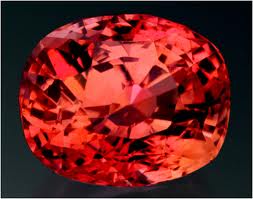
But the center will be Kage. She was a daughter of light and morning, and everything that reflects that first red light evokes her:  dawn through dew. Ruby glass. A padparadascha set in gold.

Padparadascha

Tomorrow: symbolic behaviour

Posted in Uncategorized | 2 Comments