The Readiness

Kage Baker maintained that some obstacles  are simply insurmountable.

That wasn’t fatalism. It was her observation that life will inevitably put things in your path that you cannot beat into submission or climb over. You need to be prepared for them, prepared to survive the experience. You also need to be determined to get as  much as you can of what you want, despite such obstacles falling in your way.

Some things might be insurmountable, but that didn’t mean (to Kage) that they couldn’t be outflanked. To combat the inevitable barriers, Kage made plans. Multiple plans; the first layer of which was always, Have a plan. As Shakespeare (always Kage’s favourite quotee, and still mine) commented: “The readiness is all.”*

So Kage collected an enormous fund of Things To Do When All Hell Breaks Loose – kind of vague, but also pretty useful for every disaster, foreign and domestic. A hide-out $20 in her purse; a hide-out chest of gold coins and large-denomination bills in her closet. She always carried several pens, and made sure I did as well. She procured maps everywhere we went – I think she could have navigated us anywhere on the Pacific coast of the United States, just from her enormous collection of gas-station maps.

If she got stalled on a story, she had another one in progress to try. Or a carefully coordinated series of games to play, that would restore her mind to a creative state at the end of the sequence. Computer games as Zen, sort of; it wouldn’t work for everyone, but once Kage had gone through every single one of her restorative games, she was always ready to sit down and write again. Always.

At the first symptoms of a cold, she washed down echinacea capsules with orange juice. I, personally, am uncertain of the physiological utility of this regimen, but it worked on Kage. I think it was more a matter of mind over matter than actual anti-viral properties, but what does it matter if it stops the rhinovirus in its tracks?

When she suspected influenza, the super-cure was Chinese wonton soup. When gastroenteritis threatened, it was ginger ale – that even worked on the nausea of chemotherapy and radiation. Her oncologist just nodded – he told me once he had heard of all sorts of weird things that helped his patients, and he’d learned not to argue: results were all that mattered. That was always pretty much Kage’s philosophy, as well.

Coffee, aside from its charms as an early morning aperitif, was for use against hangovers and migraines. There are actual physical reasons for this to work – caffeine is a vasoconstrictor, and since many headaches are caused by vasodilation, the correlation is obvious. I think it was enhanced by Kage’s will of iron, but there really was a physical reason it works.

Since I lack Kage’s semi-solipsism of focus – what she believed, really believed, tended to happen – I also have no talent at fighting actual chemical reactions with disbelief. (Kage managed that with only slightly more effort.) I did notice, as the years went by, that certain coffees worked better on her than others – bur I think that was purely an example of Kage’s taste in flavour. There’s no way 12 ounces of Coca Cola has the caffeine kick of a like amount of very strong Mullah’s Blend coffee. But they worked the same on Kage.

If the readiness is all, the willingness is right beside it …

I woke this morning with a bad headache, the sort of elf-shot spike in one’s temple that makes one suspect (and eventually hope) that one is about to drop dead of an exploding skull. The black and silver spikes of migraine began creeping over my vision, like a view of Sleeping Beauty’s castle as the thorns invade. Sleeping for another 4 or 5 hours helped; and when I woke, Kimberly made me a wonderful carafe of Mullah coffee. I’ve been glugging it religiously all afternoon, and can now report that I have been restored to rationality and function. Or as much of them as I ever possess, anyway.

So I’ve outflanked my migraine. And I’ve still got half a jug of good coffee left, so I will survive it in some comfort. And I can write (a little) and read (a little). It will be the Kindle tonight for sure, because I’ve just finished a paperback on the Bubonic Plague and discovered that plain print by ordinary lamplight is no longer my best activity … large back-lit fonts are my dear friends now.

But what the heck – it’s raining steadily here anyway. The fire is lit, the space heater is working, and there’s soup for dinner. If the readiness is all, as Kage believed -and as I do, too – then all is well and likely to remain so. I can scurry round the edges of the insurmountable as well as anyone.

I’ve had lessons.


If it be now, ’tis not to come. If it be not to come, it will be now. If it be not now, yet it will come—the readiness is all. 

William Shakespeare, Hamlet
 

Posted in Uncategorized | Tagged | 5 Comments

Laggers

Kage Baker liked  hopscotch. Also butterscotch, Scotch Broth soup, single-malt Scotch (especially with brownies), and See’s Scotchmallow candies.

Most of those were passions acquired in adulthood, except for Campbell’s Scotch Broth. Campbell’s stopped making that one available in California around the turn of the last century; you can still order it from Canada (the label is half in French) but that’s only happened very recently. Kage never found it in her ongoing Google project of locating extinct delectables.

Scotchmallows are, happily, still a staple at See’s Candy Kitchens. They’re not even seasonal, but can be had at any time. And we were never far from a dram of good Scotch – the specific brownies Kage favoured were only available from  our Faire friends, the amazing Jacobs family; though Pepperidge Farm Brownie cookies would do in a pinch.

She was never very good at hopscotch. Rheumatic fever as a small child left her with joints beginning to stiffen well before puberty, and hopping was not one of her strong points. However, she loved the game. She enjoyed drawing on the sidewalk with coloured chalk, and she liked selecting laggers. And she could throw and place her laggers with inhuman skill and precision. Kage was born to use artillery.

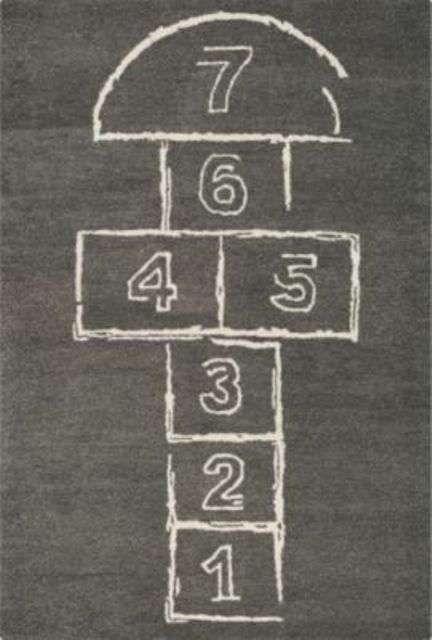
Laggers, Dear Readers, in case you grew up ignorant of hopscotch, are the markers you use when playing the game. They must be thrown so as to land in the numerically designated square of the hopscotch layout – and all those squares had to be hit in sequence to get through the pattern properly, which means you had to accurately predict where you were going.

You’d start at square 1 and go through to the end, making a full trip; next turn, you cast your lagger for the next square. Oh, and you went through the pattern hopping on one leg. If you missed, or hit the wrong one, you lost your turn and had to try again. Same if you fell over while hopping, or put your foot down, or missed a square.

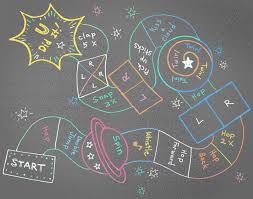
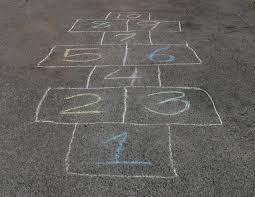
Hopscotch patterns vary wildly. They can be hand drawn,  or painted on the playground in permanent paint. They can run from 1 to infinity, but are usually from 1 to 10. There should be at least 1 double square, where you could stand with both feet; and there might be squares with other requirements, as imagination allowed. Like, if someone else’s lagger was already in a square, you had to leap over the whole damned thing.

Kage, as I said, was not so great at the hopping. But man, could she lay laggers down where she wanted!

The laggers she liked best were stones: they had some weight, and tended to stick the landing. She liked ’em faceted, too, so there was at least one flat side where the lagger  could settle – otherwise, it might roll or skip too far. Glass was always nice, as long as it was aged a little – smoothed and darkened by kicking around the pavement in the sun, a big chuck of amber beer bottle or emerald 7-Up bottle was perfect.

However, living up in the Hollywood Hills offered a fine variety in stones, as well: quartz white as sugar; rough agates striped like silk; or the finer quartz crystals that were translucent,  pale lavender or mist grey or clear as glass. You could even dig jasper and jadeite out of the hillsides, if you knew where to look. And we did. We always had interesting rocks in our pockets, and laggers were one of the things they were for.

I was a maniac for hopscotch, and used to bring my own laggers to school in my book bag. It was not honourable to have someone else throw your lagger, so I had to rely on my own short-sighted aim: but I had the same exotic rocks, so even when I threw a wild cast, it was at least a fine-looking stone. And once I could actually land the lagger in the correct square, I was set; I could hop for yards on one foot, and leap over squares rendered uninhabitable by other kids’ laggers.

Magic marks and eldritch markers. Predicting where your shots would land, and making the throw come out just right. Leaps of faith over the danger zones, clutching at the air to keep your balance … It was like walking a labyrinth, such as are set these days in some Catholic churches.  Grace Cathedral in San Francisco has one, and Kage loved to walk it round to its center. She always grinned at me as we paced it out, and I know what she was thinking: Oh, I wish I had a good lagger here!

We always need laggers, Dear Reader, to mark our path and hint at the right way. I’ll bring one, for the next time I am there, at Grace Cathedral. It would a great and good thing, to hop my way through the sacred maze.

I can toast Kage with Scotch whiskey  when I reach the end.

hopscotch 1hopscotch 2  hopscotch 3


Posted in Uncategorized | Tagged , , | 7 Comments

I Got Nothing

Kage Baker was always leery of expressing opinions on current events.  She maintained this reticence even more determinedly after taking to the aether of the Internet, because one of the first things she noticed was how insanely furious people got in conversations over that medium.

Something about finding themselves invisible made some people fearlessly angry. Something about not being able to lock eyes with people who disagreed with them made them insanely abusive. Something about feeling safe behind their electronic fences spurred them on to symbolic murder, in conversations too violent to be indulged in Real Life.

Kage had a low opinion of people, anyway – or rather, of individual human beings. Her opinion of humanity, in the abstract, was cautious but hopeful. It was specific single examples of the breed that appalled her. What goes on amid the flashing photons of the Internet only increased her natural anthropophobia: it has turned out to be – along with many other things that are actually good – a perfect environment for hateful morons.

Kage came to that conclusion quite early in her exploration of the Net, and adjusted her habits accordingly. She always felt a careful retreat and a well-maintained redoubt were much better than running, screaming noisily, away from conflict … or towards it. When her correspondents morphed into fanged, foaming trolls, she retreated.

I have never had radar as sensitive as Kage’s. I often don’t recognize an insult or an asshole until I suddenly get hit in the head with a mud pie. And my first impulse is always to scrape the mud off, add a few rocks, and pitch it right back. This leads to seriously unhappy situations, and Kage was always metaphorically (or literally, sometimes) kicking me in the shins under the table to make me shut up.

In my first solo, post-Kage explorations into the aether, I got int o a lot of fights. Same think happened in grammar school – it took me until 4th grade to figure out that banging a bully’s head into the wall did not make me his moral superior.  Kage operated as my braking system for a long, long time – all I have left is the memory of her voice, telling to calm down and retreat. Luckily, I have a good memory …

The voices in the aetheric wind are full of nastiness.

Right now, barely a week into the new year, the news is already deep in the foam of an incoming tide of Idiots In Conflict. The new Congress in Washington has set to work faster than at any other point in the last 6 years – but what they are doing with such exemplary speed is cutting benefits to the poor, the old, the sick, the veterans of our wars. They are voting precisely to the orders of their corporate masters. Consequently, all their constituents are howling and throwing stones at them and one another; screaming, depending on their viewpoint, Faster! More! or Slower! Less!

Phyllis Schafly was an infamous conservative Medusa of the 1960’s; also, appropriately enough, as stupid as a box of rocks  … To my amazement, she’s not only not dead but is still uttering perfect bullshit. She announced recently that the rise of rapes on college campuses is because “too many women are going to college”.

Jeb Bush is flirting with the idea of a Presidential run. That family aren’t bushes, they’re executive kudzu. But not to worry; Mike Huckabee, a rabid commentator from Fox News, may challenge him. What a wonderful choice …

Fundamentalist Orthodox Jews are pressuring the Israeli government to force airlines operating there to segregate their planes by gender: because they don’t want to sit next to women, and become “unclean”.

Planes continue to fall out of the Malaysian sky, scattering bodies over the drowned Sunda Plain. Oklahoma and Texas are frakking  earthquake swarms into existence. The East Coast is reminiscing about the days when New York was a mile deep in ice; the Great Lakes are freezing over – again. Europe is having its own nostalgia as it moves back into the Little Ice Age; except for their earthquakes, in Russia and Finland and Greece and Albania and Turkey. And it’s better not to think too much about Africa, which is leading the world in new ways to die from rare diseases.

And, of course, there is the latest terrorist crisis – or at least, the latest one getting publicity, since it had the gall to happen in Paris. The City of Lights and La Belle France have been a bastion of civilization for 1,000 years, if you don’t count the Black Death, the witchcraft scare, the lycanthropy epidemic, the Revolution and the Nazi invasion. And right now, it’s deep in mourning for the dozen people shot to death by Islamist fundamentalists: they invaded the offices of Charlie Hedbo – which is sort of Mad magazine a la francais – killing two police officers and 10 journalists.

Quite rightly, the world is now taking sides and showing support. Most are behind France; some are behind Islamic nations, none of which seem to have had anything to do with it. The shooters were Muslims, but they were also French.

But sides must be taken. Arguments are already blossoming all over the Interwebs. Who is to blame? Who is the most injured? Who is screaming the loudest, threatening the most people, feeling the worst pain? Who is deciding what the sides are? It’s all up for grabs.

No wonder Kage left the chatrooms and posting boards. No wonder she advised me to do the same. And no wonder at all that I did.

Goodnight, Dear Readers. I’m going to go read a book about the Plague.


Posted in Uncategorized | Tagged , , , , | 6 Comments

Books: Reading and Making

Kage Baker was an avid reader.  She started early – before kindergarten, being one of those kids who figures out the trick while their parents read to them. Kimberly did, too. They started off their school careers already  well past Dick, Jill, Sally, Puff and Spot;  I wandered into first grade knowing my alphabet but with no idea of how the letters worked. I left that way, too.

While Kage was scornfully passing up Dr. Seuss (She thought he was silly. Kind of funny, when you consider her eventual story cycle …) and Kimberly was discovering comic books, I was still in an illiterate fog. Literally, since the real problem was that – from my seat in the back of the rows – the blackboard was an enormous vista of fog and confusion. I was tall for my age and incredibly short-sighted: I got stuck at the end of the rows, and spent my school days blind. (I wouldn’t get glasses until I was 11.)

I did eventually learn to read, during the Christmas holidays of my second grade. My dad and I spent most of that time in my top bunk bed, where he finally unlocked the secrets of printing for my dim eyes. The first thing I read on my own was a Pogo cartoon; then I started in on our 7 sets of household encyclopedias. It was obvious pretty quickly that my father, by rendering me literate, had created a monster: now that I could read, I could not stop.

Dick, Jill, Sally, Puff and Spot, I discovered, were really, really dull.

By that time, my sisters were successfully deciphering cursive script. They loved Babar the Elephant. I hated it, and had a dreadful time reading anything but print. Luckily, the library turned out to have thousands of books, ALL of which were printed! I was delighted to find out that the world favoured printing over cursive; I set to reading everything I could get my hands on.

The only hand writing I could ever decipher with ease was my own, and Kage’s. Mine was judged to be a ticket to hell by the nuns who tried, vainly, to teach me Palmer script. Kage’s was even worse – she was left-handed. But at least she could spell, which saved her from a lot of rancour. I couldn’t write legibly or spell.

However, no matter how much it seems you will never escape the tyranny of penmanship classes, ultimately they have to send you on to high school. And in high school, while your teachers might yell about your horrible hand-writing, they mostly let you alone as long as you completed the work … and man, Kage and I were good at that.

High school is also where you discover typewriters, which were a gateway drug for the two of us. We wheedled used manual typewriters for birthdays, and spent hours crouched over the ancient machines, banging away until our fingers bled. Any of you, Dear Readers, who ever worked on a manual keyboard, will understand. The rest of you were born too late to experience this bone-rattling, joint-destroying, tissue-degrading past-time. I hope you’re all grateful for computer keyboards. They’re like typing on marshmallows – I don’t see how anyone even gets carpal tunnel anymore.

Once the fervour of producing  printed pages wore off a little, Kage found she actually preferred composing in long-hand. So did I; but I was getting bored partway through a plot, suddenly, and eschewing writing for the easier world of pre-written books …

So we came fairly quickly to a division of labour – Kage wrote stories in longhand that only I could read; I typed faster than she did, and soon found access to electric typewriters that made me even faster. And that was how it fell out. Kage wrote and wrote and wrote, and I typed and typed and typed. She loved the neat pages all in an identical font, that could be painstakingly sewn together and illustrated and bound. And I loved seeing her stories get longer and longer, giving me better and better worlds to explore …

Eventually, Kage learned how to compose directly on to the screen of a computer. That let her take almost complete control of the process from Idea to Book. My role changed to sounding board and research assistant. And Dedicated Reader, of course. Every version of every story ran first under my eyes – I was the last one to read a book before it was loosed into the Wild Country of publishing; I was the first one to read it when it came back tamed and bound and carrying Kage’s name into the world.

Kage couldn’t stand to look at one of her books by the time it was done. Sometimes she read them much later; mostly, she didn’t because she immediately wanted to change them. Instead, especially during her last year, I read them aloud to her – just about all of them. It’s about as close as I ever got to regretting Kage’s prolific output …

In the meantime, I have gotten very good on a keyboard. I made my living doing data entry for 40 years. And I can still read Kage’s appalling handwriting better than anyone else can. So we’re still doing the same old Book dance. I’m taking dictation from a lot further distance, but the notes are just as illegible as ever.  Sometimes, what comes out of deciphering that confusion of swirls, loops and rainbow-leaking ink is a word so peculiar and unexpected that it changes the narrative to something I had never imagined.

And that, Dear Readers, is where the stories come from: old notes, cryptic writing, sudden blinding flashes of realization.  Those are the books we are still making, Kage and I.


Posted in Uncategorized | Tagged | 6 Comments

Twelfth Night, Winter and Quiet

Kage Baker really liked 12th Night.

She never cared for the modern usage of Christmas, where it begins sometime after Halloween and ends on Christmas Day. It’s an enormous holiday (even without the religious component), and she felt it should be enjoyed more. So we celebrated the 12 classical Days of Christmas, which run from Christmas Day to January 6th: Twelfth Night.

This was a family tradition, too. And still is; our tree and lights have been up and lit for all this time, and will only come down tomorrow. The indoor deco all gets packed away; the lights get changed out. For the duration of winter, they will be blue and white outdoors, turning the now-leafless mulberry tree into a frost tree … much more fun than a porch light; although we’ll replace that with a blue bulb too.

You could be excused for mistaking our house for a DYI cryogenics lab.

Mind you, it’s been nearly that cold lately. But we are dealing with the furnace problems – it’s just slower to get it done this time of year, when ancient heating systems are failing all over the city.  And my sister and brother-in-law are unwilling to spend more on the furnace replacement than is still owed on the mortgage … but space heaters and the fireplace have kept us comfortable.

Of course, to celebrate 12th Night, the weather has decided to warm up precipitously. It’s 84 degrees outside right now, and the front door is wide open to the warm air. It’ll get down into the 40’s come nightfall – the earth is still asleep, even if the air is confused – but for now it’s unseasonably delightful to let the Halcyon weather wander in.

Even the animals like it. Especially the Corgi – there is no under on a Corgi, and Dylan was very unhappy with the days of frozen grass we had. He can’t wade through anything and not freeze his tummy. The little black cat, who is older and wiser, is just sleeping in warm chairs and watching the day through the window. She knows not to trust the heat spell. The fluffy orange kitty, though,  is sitting Spinxlike in the doorway,  sniffing the warm air incredulously – we don’t let her out because she is appallingly short-sighted even for a cat, and naive to boot: she would be eaten in short order, or knock herself out running into something. So the show through the screen and windows is always amazing for her.

The coldest part of the winter may yet be in front of us. January is usually the coldest month of the year, and February is often one of the wettest. I think most Californians will happily accept a mini-Ice Age if it means snow in the mountains or rain in the valleys. We need the water, and absurdly huge numbers of us also expect to be able to ski. The forecast is still holding out hopes for more rain, and anything will be ecstatically received.

But I think we are not looking at an El Nino year. No major floods, no graveyards washed out. It’s true that portions of the Pacific Coast Highway are walking – part of Malibu fell off the sea cliffs just today – but not enough to constitute a disaster. It’s just that so much of the coastline is not proper stone or earth – just dehydrated mud – that even a few heavy dews will collapse them.

Kage and I were once in a simultaneous mudslide and wild fire, on a flooded-to-our-hubcaps Mulholland Drive. Seasons can get pretty eccentric here in Los Angeles.

But at least, with 12th Night, we come to the quiet part of the winter. Things will be cold or warm, wet or dry, foggy or crystalline clear – but quiet. The footballers, the Parade enthusiasts, the visiting relatives: they’ve all gone home. There are few tourists wandering Hollywood Boulevard. We’ve almost run out of superannuated Christmas trees to catch fire, and the last of the holiday leftovers probably went to work and school in lunch bags this week.

Time to relax, and wait to see what comes up where the lawn froze last week. Time to watch the hills go green with wild oats; time to watch the willows and cottonwoods in the LA River begin to bud out in a green haze. Time for millions of sea gulls to spend their winter days in the parking lots of malls and McDonalds and supermarkets, sheltering from the high winter tides.

It’s time to be grateful for windows, Kage always said. Because Winter is still out here, waiting to pounce, and it’s just better to sit quietly and watch.

                                                                              Old Christmas is past,
                                                                              12th Night is the last.
                                                                              And we big you adieu,
                                                                              Great Joy to the New!


Posted in Uncategorized | 2 Comments

Is It Prophecy or Just Good Research? Only The Cards Know!

Kage Baker paid a cautious lip service to omens. She readily admitted she was superstitious; in fact, she claimed to be much more superstitious than she really was, cheerfully avowing belief in all the goofier forms of prophecy.  She claimed to read the entrails neatly packed into holiday turkeys; or ant trails; or coffee grounds (she didn’t drink much tea;) or the patterns left on her desktop coasters by innumerable glasses of Coke. Birds. Koi. Yarrow stalks. Wine lees.

Kage read Tarot cards, but disavowed any powers of prophecy through them. The cards operated on their own, she said; all she did was tell people their classical meanings. They could decide for themselves if the future indeed fell out as it was revealed in Kage’s hands. And usually, according to the seekers – it did.

She did believe in a few things; non-standard, most of them, but they seemed  consistent in her. Being overflown by a raven meant good dreams; a hummingbird sighted on the road meant safe journey. Oranges by the side of the road meant good luck travelling, too. A double fortune in a fortune cookie meant a pregnancy. A blue heron in flight meant money was coming – and it always worked. If you persist, for instance, in selling stories … well, somewhere soon money will come in. But Kage was convinced the blue herons knew before she did. And, as payment schedules in the writing trade can be weird and irregular indeed, maybe they did.

Anyway, seeing a blue heron is always an occasion for joy.

Of course, as a science fiction writer, part of Kage’s stock in trade was prophecy. But it was a special kind, an informed and analytical sort of prophecy. Kage called it a form of cold reading (at which she was also pretty good. She’d have been a terrific grifter, if not for her crippling shyness.) Of course, there are some science fiction writers who just strike off madly in all directions; somewhere in the morass of crazy-ass ideas, they sometimes hit the bull’s eye in prophecy. But most science fiction writers work from research and rational extrapolation, even the ones who aren’t actually scientists in their day jobs – and Kage thought that was much the better system.

For someone who was not a scientist, she made some damned prophecies. She decided that the heart of Mars was not quite cold – and it seems increasingly likely. She wondered where water and useful atmospheric gasses were likely to be hiding: she chose permafrost, aquifers and the polar caps, and it turns out those were good guesses.

She looked at Great Britain as it set about becoming the most surveilled population in Europe, and prophesied the Nanny State – and while there is also a growing backlash against it, it still came to be. Just today, in fact,  an article was released about the Home Office considering making nursery schools and baby sitters responsible for identifying small kids likely to become terrorists … and that’s nuttier than almost anything Kage proposed.

And food puritansim is on the rise in America; fueled, weirdly enough, by the corporate evil of Monsanto – but it’s still becoming socially unacceptable to eat meat or modern grains.

Animal advocacy was something Kage prophesied, too: but that one was intended to be a joke. No one would actually kill human beings to protect animals, would they? But some people would, and do. Worse, they also kill the animals to prevent them living with nasty humans. Kage would have been really horrified at that; who are any of us to say an animal is better off dead than domesticated? That’s pretty much the ultimate human arrogance in beast slavery.

Kage viewed the current human-caused extinction event (which many biologists do say is happening, Dear Readers) with horror and resignation. She figured people wouldn’t stop until they screwed up the biosphere enough to endanger themselves; but she also figured that the earth would survive, whether humans did or not. One of the many reasons she invented the Company was to make up for the casualties along the way; so the planet would not be permanently deprived of tigers or river dolphins or the nine species of moa: even if only in stories.

Or the pika.  Kage would have loved this one, and all its antic repercussions …

The pika is a little rodent that lives mostly in China; it is distantly related to rabbits, and burrows in great numbers, like a prairie dog. China has decided they must go, and is embarking on a wide-spread campaign of poisoning them. Many Chinese are objecting, and now so too are many non-Chinese: pikas are alarmingly cute (See mother and baby below). However, it also turns out that poisoning pikas sends all that poison flooding out into human crop lands as the little victims die in their burrows and return their constituent elements to the bosom of the Earth.plateau-pika-running-ponies

You can read the original article here, at Running Ponies: http://blogs.scientificamerican.com/running-ponies/2015/01/02/heres-why-mass-poisoning-pikas-is-a-terrible-idea-and-not-just-because-look-at-their-fat-little-faces/

Also, if all the pika die off, then there is a gap left in the ecosystem. One of the animals in a good position to move into it is the Giant Gerbil of Kazakhstan: and they are the natural reservoir for bubonic plague … there’s some nice irony for you, huh?

And speaking of natural disease reservoirs – Ebola’s has been finally identified. When Kage was researching hemorrhagic fevers in Africa for the dreadful purposes of the Plague Club, she discovered that many of the vain hunts on the ground circled around an area with lots of caves. So she made the carrier a bat. Turns out now, that the most probably culprit in the worst hit areas is … a bat. A small, cute bat, that children like to catch and play with and eat. Man, that’s right out of the Brothers Grimm!

Was it prophecy, what Kage did? I don’t know; I just fed her notes and watched her eyes spin round and come up dollar signs. Or cherries.

Or bats.


Posted in Uncategorized | Tagged , , | 6 Comments

Marking My Place

Kage Baker, like anyone else, didn’t always get things done on time. When she knew she couldn’t make a deadline, though, she tried to put a marker in place to show willing. She tried to get things completed on schedule and she hated failing: worse, she hated being seen to have slipped up.

I am trying to get a blog post in every day for as long as possible in 2015. So this is my lagger, to mark that I got this far before midnight tonight!

Posted in Uncategorized | Tagged | 2 Comments

Memories of Perseverance

Kage Baker hated putting a project aside. She hated giving up on anything – she was fanatic about keeping on at something until she had accomplished it. She was not a quitter. She wasn’t even much of a negotiator. With Kage, it was always an all or nothing effort.

It was the shining edge she brought to the task of writing, that let her cut though all distraction, confusion and outside static. She would crank the focus down on the story in front of her like  Leeuwenhoek at his first microscope; until she too could see the “.. .many very little living animalcules, very prettily a-moving…” which fascinated Leeuwenhoek. Except that his were miscroscopic animals, and hers were the characters in stories.

Kage discovered Leeuwenhoek while researching the painter Vermeer, for her story “In His Light”. She ecstatically shared the details with me, and was rather peeved that I already knew about Leeuwenhoek – as any devotee of biology does. She found his contributions to Vermeer’s work much more interesting than his 50-year association with the Royal Society, despite the amount he contributed to that august body and its deathless members like Robert Hooke, Robert Boyle and Christopher Wren.

“He helped Vermeer see the qualities of LIGHT,’ she explained, caps very firmly implied. “A painter needs to see all of light he can.”

Painting had at one time been Kage’s passion, and she tried for several years to make her living with pen and brush, ink and water colours. It lost its primacy when her writing began to take over her imagination; but, being Kage, she never gave it up. She continued to paint, and especially to illustrate and illuminate things; she loved fancy capitols and cunning alphabets, and she never really believed a story was complete without pictures. The first thing she always wanted to see in the galleys were a rough of the cover, and the editorial suggestions for the chapter heading icons.

Her work, many critics have remarked, is very visual. Yes; yes, it is – I think she was transcribing from what was actually a movie in her head, with lots of fantastic CG effects. The dialogue was over-dubbed, and she just wrote down what she saw and heard. And if you had asked Kage, that’s what she would have said she was doing. She often said she was taking dictation when she wrote.

So maybe it wasn’t that Kage never gave up on an idea, so much as that whatever was broadcasting into her head never stopped. She always did complain that her memories were crowded into the corners of her mind, by other people’s memories: she firmly believed that she’d inherited Daddy’s memories of WWII, for instance, baked into his blood by the Egyptian sun 10 years before she was conceived. I told her that was rank Lamarkism, but she said there was no way to tell. No one ever quizzed those long-necked giraffes, she commented, on what they remembered

She gave the little girl in “Her Father’s Eyes” that sort of bloodline memory; she gave it in even greater detail to the Little Stupid Guys, to help their introverted minds along. She gave the Operatives multi-tiered memories, where unpleasant information and other people’s memories could be shunted into storage, never to bother their owner again uninvited.

I think Kage longed for that kind of surcease in her own head. She never got it unless she channeled all her focus into a specific train of thought, and gave the others no chance to grab the mic. And those – both the theme in temporary charge and the others relegated to the background chorus – those were the stories. And I am quite certain that when Kage said she had to write, that was at least partly what she meant.

I think her dilithium crystals would have blown up, otherwise. Just as they would have if a sequence, once started, were stopped halfway through.

She was quite dreadfully upset when she realized she would not be able to finish Nell Gwynne II – one of the few times, in her illness, that she cried, and railed against the inevitable. She only calmed down by drilling the rest of the story into my head, and when I had recited it back enough times to convince her I had it memorized.

If Kage realized I couldn’t remember it all – I was very nearly the walking dead by the end – she also realized that was I was making it up rather than let the narrative fall into the Void. It must have been enough to make her happy; she never complained I had it wrong, even when she set about working one of my new ideas closer to her heart’s desire. She finally believed that I wouldn’t quit.

“You just have to keep going, kiddo,” she told me. “Eventually, you won’t be able to stop anyway; and then it all runs on automatic.”

I gotta tell you, Dear Readers, that what Kage didn’t mention was that once the process was running on automatic, it no longer answered to the brake. It seldom even answered to the throttle – instead, your brain began to itch and burn and fulminate, and then you realized that you were sitting on the cowcatcher of a speeding train, and all you could do was map the direction it took. The speed and compass heading were out of your control.

Kage couldn’t stop; and sensibly, she made a joy out of what had become an inevitability. Now I can’t stop, either. My head is full of the echoes of other people’s memories, all in Kage’s irresistible voice. But you know what? The candy butcher comes along regularly; the seats are comfy. And the view from up here is amazing …


Posted in Uncategorized | Tagged , , , | 5 Comments

The Virtues of Preparation

Kage Baker was a staunch proponent of preparation.

Measure twice, cut once she would intone. It’s a poor workman blames his tools. An ounce of prevention is worth a pound of cure.

A philosophy with which anyone would agree. Unless it was Kage who had been so anxious to get to a task that she had neglected to lay out all her pens, or dedicated juju, or the book she’d been hoarding on Apports Through History. When some irreplaceable portion of her kit was found to be missing an hour into the project, all hell broke loose.The hounds were released, Harry would shout and sing and jump up and down on his perch, and the entire household would be scrambled to find the pertinent artifact.

And when once Kage was finally settled with all she needed to hand, she would usually remind me severely that this was why is was so important to get everything set up within arms reach before you started.

“I’m not the one who misplaced your sextant,” I would protest.

“Not this time. But usually, you are,” Kage would say.

Which was a fair cop. It usually takes me two or three tries to get settled down with all my tools when I sit down to sew, or knit, or do the taxes, or wrap presents. And even when I have everything at the start, the Scotch tape or the scissors or the whole freaking pattern   crawls away and hides as soon as I get thoroughly engrossed.

Today, I decided that knitting would be my in-between task; this, as opposed to reading and eating Christmas cookies, which have been my displacement activities for the last fortnight. And I like to have more than one project on the needles at once. That way, if I grow weary or exasperated with one, I can turn to the other for a while. It clears my mind for the day’s writing, and is also a nice activity during family time with the telly.

“Knitting.” Kimberly told me this weekend, “is how busy people sit still.”

I like that. It makes me feel … competent. Kimberly also likes hand work; she can knit, but is a whiz at crochet. It being the season for charitable activity, I’ve found a nice project we can work on together – knitting and crocheting blankets for the children of wounded veterans.

I like knitting for military folks, and their families. I’ve made socks and scarves and caps. I’cw knitted balaclavas for the troops on duty in Afghanistan. I liked working on those during Dickens Fair especially, as it was something ladies did in England in the 19th century – and now we needed to do it again in 21st century America. It was a useful project, and it gave me something to talk about with the audience, something they could really understand.

Blankies for kids whose moms or dads are far away – or missing – or home, but wounded … well, that seems very important. Kimberly and I were both eager to start today. We went and shopped for just the right yarns, just the right needles and hooks; came home and set right to it.

I promptly screwed up my pattern, forgetting entirely what I was trying to produce. Thus, I first knit 10 rows on my blanket, then tinked the last 3. “Tinking” in knitting: backwards. There are two ways of taking out errors – ripping out all the stitches, or tinking. Tearing out is fast, and if you are very handy you’ll be able to recapture all the unsecured stitches without dropping any and producing a hole in the finished fabric. Tinking takes longer, but you don’t loosen a stitch before it’s on a second needle: so you never lose any, and can pick up your fabric again with a smooth margin.

I tinked a lot today. Then I got up for  but a moment, leaving my knitting on the couch – and when I returned, Harry had fulfilled one of his lasting heart’s desires and attacked my knitting in my absence. He always does this with great cunning and in fiendish silence – by the time he got caught at it, he had chewed the square end of one knitting needle into a round knob. The other needle he had yanked right out of the knitting (dropping 3 stitches into the bargain), and split the long shaft of it like an exploding cigar or a banana peel cannon in a Warner Brothers cartoon.

banana peel gun

So I went hunting through my knitting supplies for another pair of needles the same size. I found needles of steel, needles of a rare woods like rosewood and ebony; carbon fibre needles, bone needles; oak, ash and thorn needles. Needles in every size from 0 to 15, suitable for faerie lace or fishing nets: and finally, ONE (1)!! pair of plain bamboo No. 10’s, unchewed by my evolved dinosaur …

And when I had gotten all the fabric picked up and re-knitted and facing the right direction on the new needles – then, Dear Readers, I discovered I had forgotten to change the body of the blanket to the second colour in my pattern, and was blithely and blindly knitting across in the trim colour. So I tinked another couple rows.

At this point, I decided I’d had quite enough displacement activity and it was time to get to writing, My writing cap was firmly settled, the  festive tassel just finishing its first parabola at the back of my head, when it was suddenly time for dinner …

But now Harry has gone to bed. I’ve found my second colour yarn and am ready to resume knitting a blankie. And if I’d just remembered Kage’s advice about being ready a little sooner, I’d be a good hand’s span into the finished product by now, instead of making the tremulous shift from edging to body.

But, hey, it’s no loss in the long run. I have my scissor now, my tape measure shaped like a sheep, my Knitters Dictionary in case I forget how to purl, my pretty glass knitter’s rosary to count rows. I have my pattern and all the colours called for in it. And Kimberly is two crocheted squares ahead of my knitting, so I have incentive to get it right and caught up, too.

Knitting or tinking, Dear Readers: as long as there’s a prayer in every stitch, it all comes out right in the end. As long as you’re prepared.


Posted in Uncategorized | Tagged , | 8 Comments

New Year’s Day 2015

Kage Baker, as I have described before, liked to take the week between Christmas and New Year as a sacred space. A hidden place, a haven; a comfortably “non-time” wherein to seek release from the weight from the year’s toil just past and flex your shoulders before the next year’s load lands. Several cultures have assigned this neutral quality to the changeover of years, and Kage thought it a very fine idea.

Hence our life-long habit of lolling around all New Year’s Day, eating leftover Christmas sweeties and the new feast of January 1st, playing with our toys … mind you, Kage usually wrote a bit, as well, but that wasn’t work. That was indulgence in her OCD (or so she claimed) or sometimes experimentation with something for which she had no purpose. Yet.

A lot of stories grew out of these non-times. Conventions were non-times, except for the portions Kage actually spent in a panel; the rest of any given convention, we were in the bar, the restaurant, the bar outside the Dealers Room, the bar beside the pool, the bar in the Green Room, or in our own room looking through the Room Service menu …

The Bird of the River was entirely worked out in the golden oak-walled bar of a hotel in Kansas City, MO over an endless supply of Planter’s Punch (Kage) and coffee (me). The second section of Anvil of the World was outlined at a BayCon one May in 2007;”Running The Snake” at the same convention in 2006. Nell Gwynne II was written in large part at the Nebula convention in Cocoa Beach, FL in 2010 … by me, in between adding Nebula pins to Kage’s awards pinned to my Hawaiian shirt.

And every road trip was a sanctuary of non-time, wherein we plotted literarily and literally, but mostly had a grand time being invisible and untraceable on the Never Ending Road. No one could find us then. Even after cell phones took over the world, it wasn’t easy to find us … one is only a slave to one’s shackles, Kage pointed out, if you answer the damned phone. And we almost never did.

Still. The non-times, the quiet times; the brief vacations on floating  islands, in dubious lands, in Hy-Brazil or Avalon or Tir na nOg – those may have been stolen hours, but they were never free. They had to be paid for, eventually. Best of payments was something made in their sacred sanctuary. something woven of fire and sea foam and bright metals and dark wines, and carried back to the Fields We Know hidden in one’s bosom … whereupon you might be lucky and allowed to free the newly-born by shedding your coat. Or maybe you had to slice open your heart.  And you never knew which until you came back.

Oh, but it’s worth it, Dear Readers. Both the heart’s ease and the heart’s blood are worth   it – for the journey, for the singing of the strands under your fingers as you weave, for the clearing fog that finally lifts from unknown vistas and a glimpse of the face of a god.

A new year’s day, every non-time.


Posted in Uncategorized | Tagged | 2 Comments