Kage Baker was, in her heart of hearts, an illuminator. Barring the problems of being the wrong nationality, the wrong gender and being born half a millenium too late, she’d have loved the life of a book-making Irish monk.
When she was in her early teens, she hand-made several books.Typed them out, sewed the little packets together (and she was no seamstress) and then bound them in the cardboard backings from yellow legal pads and covered them with gaffers tape; which she then painted, in order to make them more glorious. And all of them were copiously illustrated, in inks and water colours.
They were her own stories, of course, furiously typed with her patented Chico-Marx-playing-the-piano two-fingered staccato style – she never learned to type. She had an old black Royal that Momma got her, and it worked pretty well. Some of the keys were askew, wrenched out of their alignment by the unexpected Superbaby grip of our youngest sister. And the E was worn nearly away on its button, so that Kage had inked it in with a Cro-Quill and Higgins black … but she could go along at a furious rate on the thing.
Since the narrative was typed on onion-skin paper, while the illustrations were done on water colour paper, the books all had an interesting … rippled quality. And the acrylic clung oddly to the metallic gaffers tape, although from arm’s distance it made them look a little as if they were bound in rough leather. Which was cool.
They were labours of love, because Kage loved illustrations and thought that no book was a real book unless it had pictures. So her first ones did.
When her mature books began to sell … well, she desperately wanted pictures. However, grown-up hardcovers don’t get those. And to her vast disappointment, new authors get, like, zero input on what appears on the covers. Kage grew resigned to the problem very quickly – she was pragmatic, she wanted the books published most of all. And so she learned to be amused at what turned up on her book covers, and occasionally delighted by the surprises various cover artists wrought.
The cover of the UK edition of In The Garden of Iden, for example, was a right bodice ripper: some dark-haired wench staring off all mooney-eyed into the distance, dressed like a genteel Gypsy. Kage guessed the Brits figured a Spanish heroine had to be dark. The US paperback, though, had stained glass and a lady in almost-perfect headgear: it was done by the excellent Tom Canty, who was immediately entered into Kage’s list of secular saints. She loved all his covers.
When Tor – bless them! – set out to re-publish the entire Company series, they did all the covers in matching styles. Not a bad style, mind you, but very science-fictional – Iden has a monorail rushing straight at the viewer. The Tor cover for Sky Coyote has an actually grand illustration of the gates of New World One – it’s an enormous improvement over the original from Harcourt Brace, which has a guy in a coyote head hood, evidently projectile vomiting flying saucers … and even that was better than the Israeli version, which has a bipedal German Shepherd in a trench coat.
Tor’s covers went on to showcase an inexplicable portrait of Patrick Stewart on Children of the Company, which cracked Kage up: her personal vision of Labienus, who figures largely in that volume, looks a lot like Sir Patrick, but she never told anyone that but me. Oddly enough, the secondary figure on that cover is an excellent representation of Porfirio, of Mendoza In Hollywood; who isn’t in that book at all.
This uneven quality continued all during her career. Hence the amusement. But often, the covers – while nothing Kage would have done herself – were beautiful and thoughtful, and she loved them. Some unknown genius did the cover and copious illustrations for the Russian version of Anvil of the World. The pictures were so beautiful that they became Kage’s favourites, and quite offset the fact that the text was apparently printed on toilet paper. Mike Dingenberg did a gorgeous cover for Mother Aegypt. He also did an hysterical interior illo of its wretched hero dressed as the Devil and riding on a giant mutant rooster, and he let her post it on her site. J.K. Potter did a number of utterly exquisite covers, including the lovelies for all 3 Nell Gwynne books: Kage only ever saw the first one, but I can testify that she was thrilled – she’d have loved the new ones, too. And Tom Canty’s work always delighted her.
The only cover on which Kage actually had direct input, though, was The Hotel Under the Sand. The wonderful people at Tachyon listened carefully, and produced exactly the cover that Kage wanted. It was her first (and only) children’s book, and written for our niece Emma in the literal twilight of Kage’s life. So bless you all at Tachyon, for giving her that.
And now Tachyon is about to publish In The Company of Thieves. Obviously, I am leaping about in delight at this, since it will include my very first effort at a Company story. I am so, so, giddily happy that it is from Tachyon .. being me, and not really thinking about covers, I had never even asked what they had in mind. But when they sent me the cover today – thank you, Jill! – I was stunned.
And here it is:
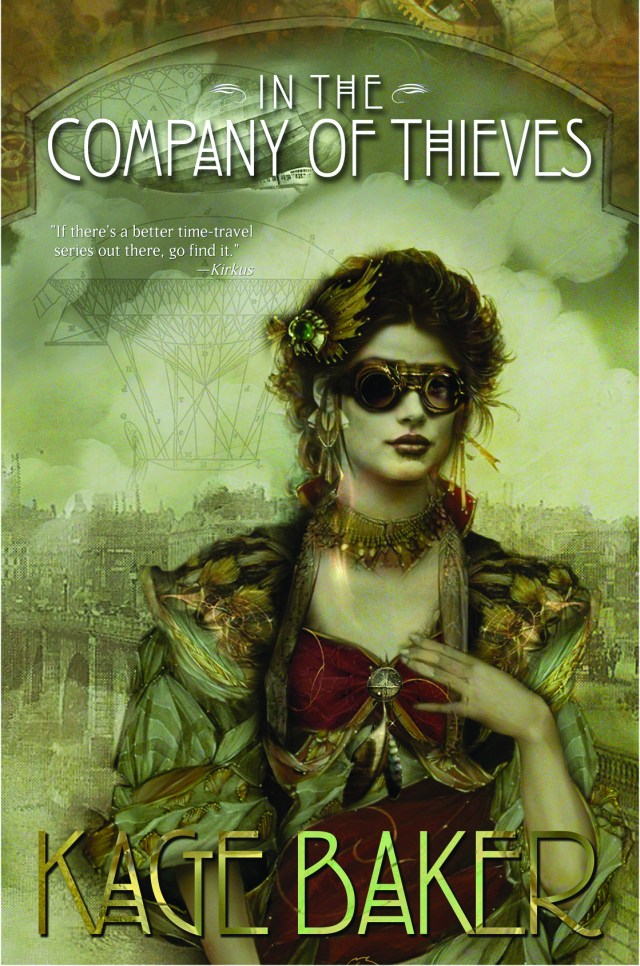 It’s by Tom Canty, which is only appropriate. I think it’s wonderful. And the strangest thing is – if you look at the hair, the chin and jaw, the narrow, long-fingered hand – it looks a lot like Kage. Around age 17 or so; and in the last few days of her life, when the cancer had pared her down to a glowing memory of youth.
She’d have loved the goggles.


